
JLG vs Genie Boom Lift: The Ultimate 2026 Head-to-Head Comparison
Posted by United Lift LLC on
You might think choosing between a JLG vs Genie boom lift comes down to whether you prefer orange or blue. It doesn't. The real difference reveals itself years later when you're reviewing maintenance logs or checking the latest resale values. Investing in a boom lift is a high-capital decision. You shouldn't have to worry about whether your equipment will hold its value or spend its life in the repair shop while your crew waits on the ground.
We know that comparing technical specs and maintenance costs can be frustrating. You need a machine that works as hard as your team does. This guide delivers a clear, side-by-side look at performance and long-term ROI for 2026. We'll show you why JLG currently holds the number one spot for reliability and how Genie's modular components can simplify your upkeep. You'll gain the knowledge needed to pick the perfect lift for your specific job site and budget with total confidence.
Key Takeaways
- Identify whether JLG's heavy-duty reach or Genie's user-friendly design better suits your crew's daily operational needs.
- Understand the maintenance trade-offs between Genie's modular parts and JLG's industry-leading reliability rankings for 2026.
- Analyze the JLG vs Genie boom lift resale market to ensure your equipment remains a valuable asset for years to come.
- Discover how total cost of ownership impacts your bottom line, including the role of proprietary parts and service intervals.
- Apply a specific decision framework to choose a lift based on your unique job site terrain and height requirements.
JLG vs. Genie: A High-Level Breakdown of the Industry Giants
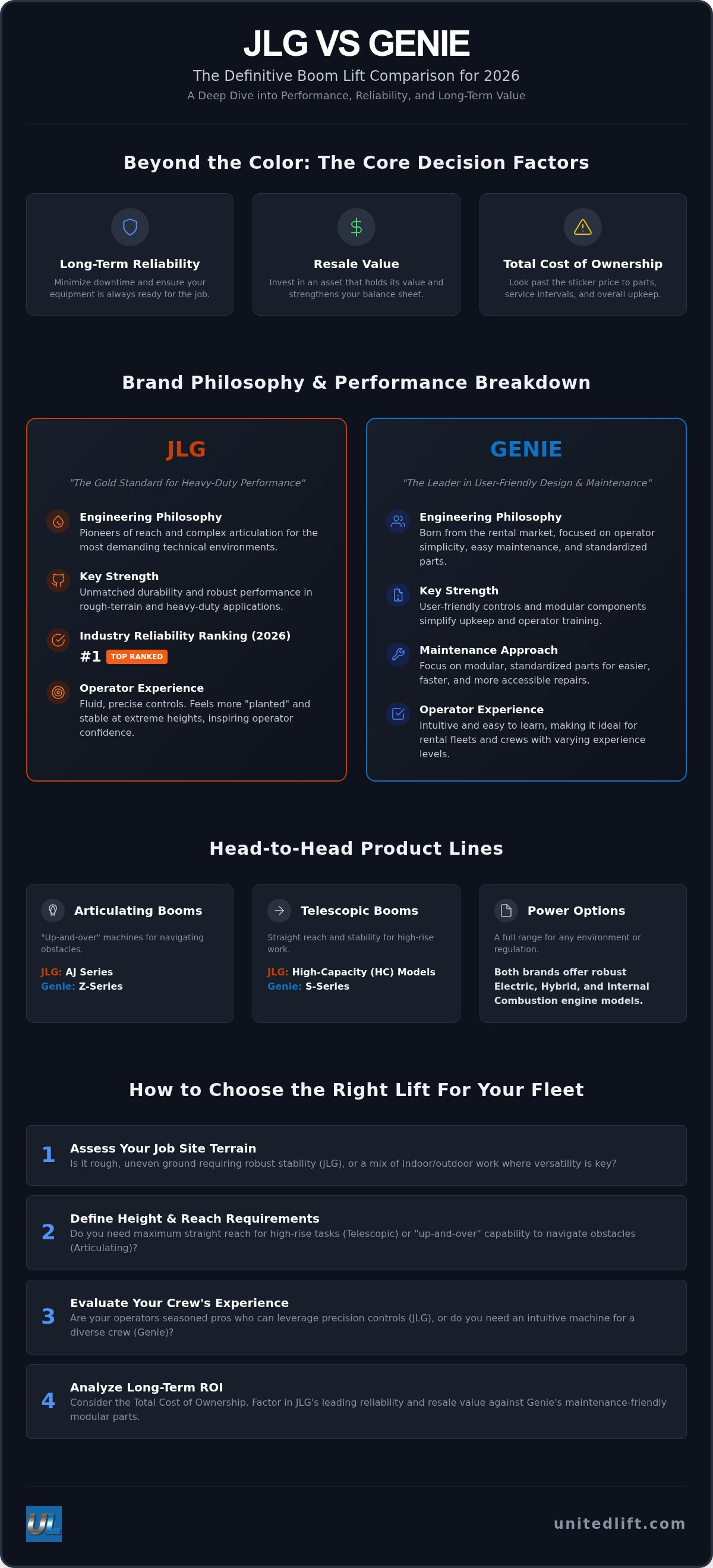
If you see a boom lift on a major construction site, it's almost certainly orange or blue. This duopoly between JLG and Genie isn't an accident. These two manufacturers represent the vast majority of the premium market share for good reason. Choosing a JLG vs Genie boom lift is a safe bet because both brands offer extensive parts networks and high reliability. You aren't just buying a machine; you're buying into an ecosystem of support that keeps your projects moving and your crews safe.
Many buyers focus only on the sticker price. We look at the bigger picture. Whether you choose the rugged engineering of a JLG or the intuitive design of a Genie, financing and tax incentives like Section 179 play a huge role in your total cost. Because we carry both brands, we can provide neutral advice on how to leverage these financial tools to grow your fleet without draining your cash flow. It's about finding the right machine that fits your balance sheet as well as it fits your job site.
Brand Heritage and Engineering Philosophy
JLG started with a focus on pioneering the very concept of the Aerial work platform. Their philosophy centers on reach and complex articulation. They build machines for the most demanding technical environments where precision is everything. Genie took a different path. They grew by perfecting the "Genie Hoist" and focusing on the rental market. This led to a design philosophy that prioritizes operator simplicity and standardized parts. One brand pushes the limits of what a lift can do, while the other perfects how easily a crew can use it on day one.
Key Product Line Overlap
Both brands compete head-to-head in every major category. You'll find a direct match for almost any application. This competition keeps both companies innovative and ensures you have options regardless of your specific requirements.
- Articulating Booms: JLG's AJ series competes directly with Genie's Z-series. These are your "up-and-over" machines designed for navigating obstacles.
- Telescopic Booms: JLG's high-capacity (HC) models face off against Genie's S-series. These provide the straight reach and stability needed for high-rise work.
- Power Options: Both manufacturers offer traditional internal combustion engines alongside a growing list of electric and hybrid models for indoor or low-emission zones.
Industry trust for both manufacturers is at an all-time high. Whether you prioritize JLG's reputation for heavy-duty durability or Genie's reputation for maintenance ease, you're investing in a machine with a proven track record. The choice often comes down to your specific fleet strategy and which brand's controls your operators prefer.
The Case for JLG: Innovation and Heavy-Duty Performance
JLG often earns the "Gold Standard" title because of its relentless focus on engineering durability. In the 2026 industry reliability rankings, JLG secured the #1 spot, proving it's built for the long haul. When you compare a JLG vs Genie boom lift, the JLG often feels more robust in rough-terrain construction environments. Its advanced hydraulic systems provide a level of stability that gives operators confidence when working at extreme heights. This ruggedness makes them a favorite for steel erection, heavy masonry, and large-scale industrial builds where the environment is unforgiving.
Versatility is another major factor in the JLG vs Genie boom lift debate. JLG’s ES (Electric Series) has redefined what an electric machine can do, offering the power for outdoor rough terrain with the clean operation needed for indoor work. Combined with telematics like ClearSky Smart Fleet for real-time diagnostics, JLG remains the top choice for owners who prioritize technical performance and long-term durability. If you're looking for a machine that minimizes downtime through smart technology, you can view our available boom lifts to see which JLG models fit your current fleet needs.
Precision Controls and Operator Confidence
Smoothness matters when you're 150 feet in the air. JLG's articulation and platform leveling are exceptionally fluid, which reduces the "bounce" often felt in lighter machines. Their joystick configurations are designed for intuitive use, allowing for micro-adjustments that speed up work near delicate structures. This precision isn't just about comfort; it's a safety feature. Better control means fewer accidents and faster cycle times on the job site. Operators frequently report that JLG machines feel more "planted" during high-reach maneuvers, which directly impacts their productivity throughout the day.
Superior Reach and Articulation Capabilities
Speed is another JLG hallmark. Their QuikStik technology allows the boom to lower to the ground and return to height much faster than traditional systems. This is a game-changer for tasks requiring frequent repositioning. In the growing Telescopic Boom Lift Market, JLG stands out by managing weight distribution effectively in high-capacity models. This allows them to support heavier materials at greater heights without sacrificing stability. Their HC (High Capacity) models are specifically engineered for those heavy-duty loads that would strain lesser machines, making them indispensable for modern, high-rise infrastructure projects.
The Case for Genie: User-Friendly Design and Maintenance Ease
Genie has built its empire on a simple premise: a boom lift should be easy to operate and even easier to fix. This practical approach made them the undisputed "Rental Standard" across North America. When you're weighing a JLG vs Genie boom lift for a busy job site, Genie often stands out for its high uptime and operator-first design. It's the go-to choice for fleets where multiple people might handle the same machine throughout a single week. You don't want your crew wasting hours reading manuals or navigating complex digital interfaces. You want them in the air and working.
The Z-series articulating boom lifts were a genuine revolution in "up and over" reach. They provided a level of flexibility that made navigating complex steel structures or overhead utilities much simpler. This design philosophy continues today. Genie machines are built to be intuitive, allowing operators to position themselves quickly without fighting the machine's geometry. While JLG is often favored for smooth, precise controls, Genie is frequently praised for its solid and dependable feel in rugged conditions. It's a machine that feels substantial and predictable, which is exactly what a multi-operator fleet requires.
Intuitive Controls and Training Efficiency
One of Genie's biggest strengths is control panel standardization. Whether your operator is using a small telescopic unit or a massive articulating boom, the layout remains remarkably consistent. This consistency significantly reduces the learning curve for new hires or temporary workers. Safety is enhanced because the controls are straightforward. There aren't layers of complex menus to navigate during critical maneuvers. This simplicity allows operators to focus on their surroundings rather than their control panel. When training efficiency is a priority, Genie’s standardized approach saves you time and money.
Serviceability and Parts Availability
Maintenance ease is where Genie truly shines for fleet managers. Their engineers prioritize ground-level serviceability to keep your machines moving. Many models feature swing-out engine trays and clearly labeled, accessible hydraulic manifolds. These design choices mean your mechanics spend less time digging through the chassis and more time performing actual repairs. Because Genie is a global brand under the Terex umbrella, parts availability is rarely an issue. Standardized components across different models also mean you can keep a leaner parts inventory. When every hour of downtime counts, Genie's focus on design simplicity ensures your equipment returns to service as quickly as possible. This makes the JLG vs Genie boom lift comparison particularly interesting for those focused on long-term maintenance costs.
Total Cost of Ownership: Maintenance, Resale, and Longevity
Buying a boom lift is a major capital investment. You have to look beyond the initial invoice to understand the true financial impact. The total cost of a JLG vs Genie boom lift includes fuel consumption, routine service, and what the machine is worth when you're ready to trade it in. JLG currently holds the #1 spot for industry reliability, which often translates to a longer service life and fewer unscheduled repairs. Genie ranks closely at #2, offering a design that prioritizes modularity to keep short-term maintenance costs manageable.
Both brands are engineered to last 15 to 20 years with proper care. However, the cost of proprietary parts and the complexity of hydraulic systems can vary. JLG machines are often cited for having the lowest long-term maintenance costs due to their heavy-duty construction. Genie counters this with parts standardization, allowing fleet managers to keep a leaner inventory of spares. If you want to maximize your ROI, you need to balance these maintenance styles against your crew's ability to perform in-house repairs. You can browse our boom lift inventory to compare specific models and their service requirements.
When repairs exceed your crew's in-house capabilities, especially for complex hydraulic issues, visit Ms. Hydraulics LLC for expert mobile support.
Resale Value in the Pre-Owned Market
JLG often commands a premium in the secondary market. Their "Gold Standard" reputation means used buyers are typically willing to pay a higher percentage of the original retail price. This brand recognition is a powerful tool for your balance sheet. Genie units also enjoy high demand, particularly in the rental sector. Rental companies value Genie for its ease of use and the speed at which it can be serviced between contracts. At United Lift, we stock both brands because we understand that different fleet strategies require different resale outcomes. Whether you prioritize the top-tier resale value of a JLG or the high liquidity of a Genie, both options represent a secure asset.
Durability and Wear-and-Tear Comparison
Build quality determines how often your machine stays in the shop. JLG uses high-grade structural steel and reinforced pivot points designed to withstand the constant vibration of rough-terrain environments. This helps prevent the structural "looseness" that can develop in older machines. Genie focuses on electrical system reliability and accessible hydraulic manifolds that simplify troubleshooting. Regarding the exterior, JLG's paint and finish typically offer slightly better resistance to corrosion in harsh coastal or industrial environments than Genie's standard coating. These small differences in wear-and-tear resistance add up over a decade of ownership, directly affecting your final resale price.
Making the Choice: Which Boom Lift Fits Your Fleet Strategy?
Deciding on a JLG vs Genie boom lift requires a shift from comparing specs to analyzing your specific operational reality. Both brands are industry leaders, so the "wrong" choice is rare. The best choice is the one that aligns with your crew's skills and your financial goals. Use this four-step framework to finalize your decision:
- Define the environment: Will the machine live on a flat warehouse floor or a muddy construction site?
- Evaluate operator experience: Do your operators already have a preference or training on a specific control layout?
- Calculate long-term ROI: Are you prioritizing JLG’s higher resale value or Genie’s lower short-term maintenance costs?
- Verify dealer proximity: Ensure you have a partner like United Lift who provides national support and easy access to parts for whichever brand you choose.
Balancing upfront capital with long-term reliability is the core of any fleet strategy. While a premium JLG might require more initial financing, the reduced downtime often pays for that gap over the first five years. Conversely, if your project requires a rapid rollout for a large, varied crew, Genie’s standardized controls can get your team working faster with less training friction.
Scenario-Based Selection Guide
Different job sites demand different strengths. Here is how the JLG vs Genie boom lift comparison plays out in real-world scenarios:
- Tight Indoor Spaces: Both the Genie Z-series and JLG ES series offer excellent zero-emission performance. However, the JLG ES series is often favored for its compact footprint and precise electronic steering in narrow aisles.
- Heavy Outdoor Construction: JLG telescopic booms are the heavy hitters here. Their superior structural rigidity makes them the better choice for high-capacity work in high-wind or rough-terrain conditions.
- High-Turnover Rental Fleets: Genie remains the industry favorite for rental-style environments. Their machines are built to be "operator-proof" with simple, durable interfaces that survive frequent use by different crews.
Financing and Tax Advantages for 2026
The financial side of the purchase is just as important as the hydraulic specs. For 2026, savvy buyers are leveraging Section 179 tax deductions to write off the full purchase price of their equipment in the first year. This incentive makes it much easier to invest in a premium JLG or Genie without straining your annual budget. We offer flexible financing options to help you bridge the gap between needing a machine and owning one. For more tips on building a high-performance fleet, check out our Forklift Buying Guide which covers similar strategic investment principles for industrial success.
Your final choice should reflect where your business is going, not just where it is today. Whether you need the precision of a JLG or the simplicity of a Genie, we are here to ensure you get the right machine delivered to your site with full support.
Secure Your Next High-Reach Asset Today
Choosing between the rugged precision of JLG and the intuitive simplicity of Genie doesn't have to be a struggle. You now understand how JLG leads in technical reliability and resale value, while Genie excels in operator simplicity and rapid serviceability. Both brands represent the peak of aerial lift technology for 2026. Determining the winner of a JLG vs Genie boom lift comparison depends entirely on your project's unique demands and your crew's specific needs.
We're ready to help you put the right machine to work. Our new and pre-owned inventory is updated daily to ensure you always have access to the best equipment in the industry. We provide national delivery on all boom lifts and offer financing available for all credit types, making it easier than ever to invest in your business's future.
Ready to upgrade your fleet? Browse Our Inventory of JLG and Genie Boom Lifts and find the perfect fit for your next job site. We're here to help you reach your goals with confidence.
Frequently Asked Questions
Is JLG better than Genie for rough terrain?
JLG is frequently considered the superior choice for rough terrain due to its heavy-duty construction and reinforced pivot points. While Genie models are dependable in rugged conditions, JLG's top reliability ranking reflects its ability to withstand harsh construction environments. If your job site involves extreme uneven ground or heavy vibration, JLG's engineering often provides more stability and lower long-term structural wear.
Which boom lift has a better resale value, JLG or Genie?
JLG typically holds a slightly higher resale value in the pre-owned market due to its reputation for durability. Used buyers often pay a premium for the JLG brand name and its extensive global parts network. However, Genie units are highly liquid and sell quickly because they are the preferred standard for the rental industry. Both brands are secure assets that maintain significant value over time.
Are Genie and JLG parts interchangeable?
No, the vast majority of Genie and JLG parts are proprietary and cannot be interchanged. While some third-party components like engines or certain tire sizes might overlap, hydraulic manifolds, control systems, and structural pins are brand-specific. Using the wrong parts can compromise safety and void your warranty. It's always best to consult your specific model's manual before attempting any component replacements.
Which brand is easier for operators to learn quickly?
Genie is widely recognized as the easier brand for operators to learn because of its standardized control panels. Whether you're using a telescopic or articulating model, the interface remains consistent across the fleet. This reduces training time for new hires and temporary workers. While the JLG vs Genie boom lift comparison often highlights JLG's precision, Genie's simplicity is a major advantage for multi-operator environments.
What is the most common articulating boom lift for warehouse use?
The Genie Z-series and JLG ES series are the most common articulating boom lifts for warehouse applications. Genie's Z-series is famous for its "up and over" reach, which is perfect for navigating tight racking. JLG's ES series is often chosen for its narrow chassis and precise electronic steering. Both manufacturers offer zero-emission electric versions that are ideal for indoor environments with limited ventilation.
How often do JLG and Genie boom lifts require service?
Both manufacturers require a comprehensive annual inspection and regular preventative maintenance every 250 to 500 operating hours. You should also perform daily pre-operation checks and weekly visual inspections of hydraulic lines and battery levels. Sticking to these schedules is vital for maintaining your machine's warranty and ensuring safe operation. Neglecting routine service can lead to expensive part failures and decreased resale value.
Can I finance a used JLG or Genie boom lift?
Yes, you can finance both new and pre-owned equipment through United Lift. We offer flexible financing options for all credit types to help you grow your fleet without depleting your cash reserves. This is a smart way to acquire a premium JLG vs Genie boom lift while preserving capital for other operational needs. Many buyers also use financing to take advantage of Section 179 tax deductions.
What are the ANSI safety standards for boom lifts in 2026?
The current safety requirements are governed by the ANSI A92.22 Safe Use and A92.24 Training Standards. These regulations require all operators to be trained and certified on the specific type of equipment they are using. Additionally, operators must be tied off at all times using a personal fall arrest system when working from the basket. These standards remain the key compliance requirement for all job sites in 2026.
- Tags: Aerial Lifts, Boom Lifts, Construction Equipment, Equipment Comparison, Equipment Maintenance, Genie, JLG, JLG vs Genie boom lift, Resale Value
