
Affordable Heavy Equipment Financing Options: A 2026 Business Guide
Posted by United Lift LLC on
The lowest monthly payment may not be the most affordable choice for your business. Paying upfront for a forklift or other lift can leave less cash for day-to-day operations, while a lease creates a different kind of commitment. The right affordable heavy equipment financing options depend on the work ahead, your cash flow, and whether you want to own the equipment.
You need reliable equipment without putting unnecessary pressure on the rest of the business. United Lift facilitates capital equipment loans and leasing options for business customers buying new or pre-owned forklifts, boom lifts, telehandlers, and scissor lifts. Compare each route against your operating needs, not just its monthly payment.
This 2026 guide explains common financing routes, including equipment loans and lease structures. It also shows how to weigh cash flow, total commitment, and ownership goals, and what information to gather before discussing financing.
Key Takeaways
- Start with the job the equipment needs to do, the conditions where it will operate, and the effect of delaying a purchase.
- Compare affordable heavy equipment financing options by structure, ownership considerations, and the questions each route raises.
- Assess affordability against expected use, available cash flow, the full scheduled commitment, and your ownership plans.
- Prepare details about equipment type, intended use, purchase timing, and whether you prefer new or pre-owned equipment.
- United Lift facilitates capital equipment loans and leasing options alongside new and pre-owned forklifts and other material-handling equipment.
When Are Affordable Heavy Equipment Financing Options Worth Considering?
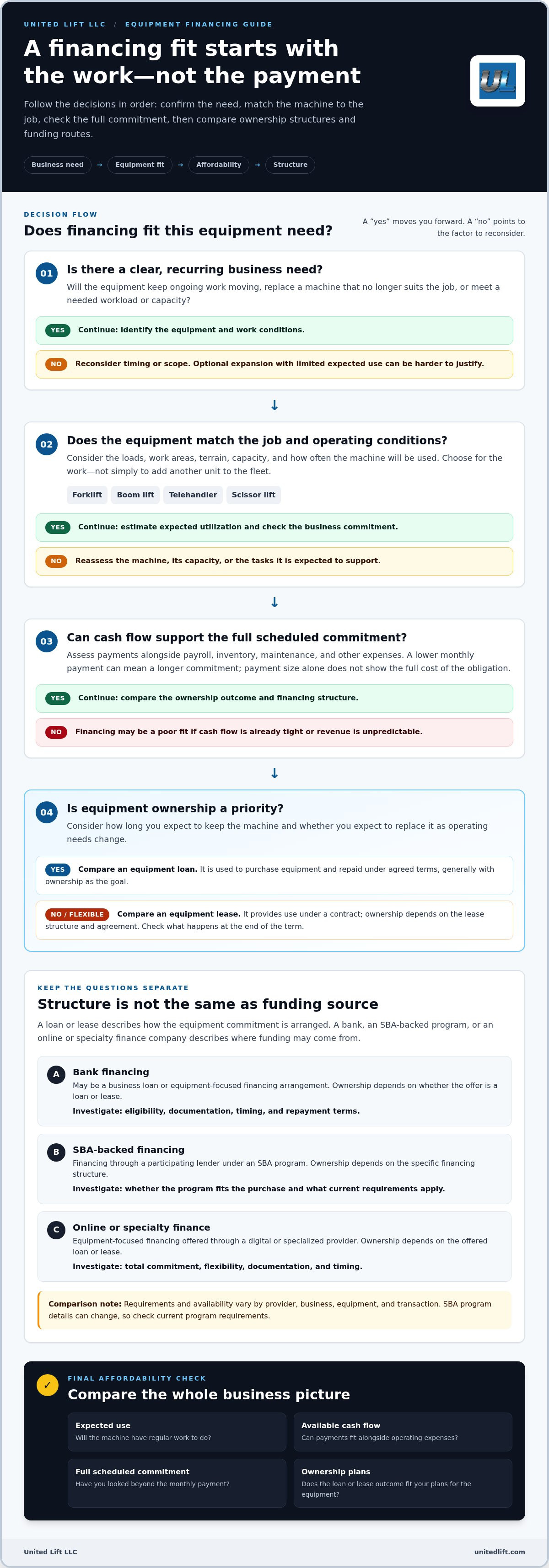
Start with the job, not the payment. Is your current forklift limiting the loads or work areas your team can handle? Do you need a replacement to keep warehouse, construction, or industrial work moving? Consider the operating conditions, how often the equipment will be used, and what delaying the purchase would mean. Financing is worth exploring when the equipment addresses a clear business need and the payment commitment fits the company’s finances.
Equipment financing spreads the commitment for a business equipment purchase over time instead of requiring the full purchase amount upfront. With a loan, the business borrows to buy the equipment and repays the debt under agreed terms, with the purchase intended to result in ownership. A lease lets the business use equipment under a contract, with ownership depending on the lease structure. For a foundational overview, see Equipment Leasing.
Spreading a purchase can leave more working capital available for other operating needs, but it doesn’t make the equipment free or remove the obligation. Payments still need to fit alongside payroll, inventory, maintenance, and other expenses. Affordable heavy equipment financing options should support the operation without putting those needs at risk.
Which equipment needs might financing help address?
Consider a forklift needed to move materials through a warehouse, handle a different workload, or replace equipment that no longer suits the job. For work at height or across varied terrain, a boom lift, telehandler, or scissor lift may be relevant. Choose based on the work conditions and capacity the operation needs, not simply on adding another machine to the fleet.
Separate essential purchases from optional expansion. A replacement or capacity need may have a direct role in ongoing work. An additional unit may be useful, but if it will see limited use, its financing commitment could be harder to justify. Estimate expected utilization and identify the tasks the equipment will support before comparing payment structures.
When can financing be a poor fit?
A payment commitment may be difficult to manage if revenue is unpredictable or cash flow is already tight. Low expected utilization can also weaken the case: the business could be making payments on equipment that has little regular work to do. Ask whether the equipment fills a recurring operational need and whether that need is likely to continue over the financing period.
Don’t judge affordability by the monthly payment alone. A lower payment can come with a longer commitment, while a lease and a loan may differ in total obligations and ownership outcome. Review the full scheduled commitment alongside expected use, other business expenses, and the plan for the equipment at the end of the agreement.
United Lift facilitates capital equipment loans and leasing options for business customers considering material-handling equipment. Keep the equipment choice and financing discussion connected: identify the job, choose equipment that fits it, then assess whether the commitment works for the business.
What Heavy Equipment Financing Options Can Businesses Compare?
Financing structures and funding sources are related, but they aren’t the same thing. A loan or lease describes how the equipment commitment is arranged. A bank, an SBA-backed program, or an online or specialty finance company describes where funding may come from. Separating those questions helps you compare affordable heavy equipment financing options for a forklift or another lift purchase.
The table is a starting point, not a promise of eligibility or terms. Requirements and availability vary with the provider, business, equipment, and transaction. SBA program details can change, so factor current program requirements into your comparison.
| Funding route | Common structure | Ownership consideration | Questions to investigate |
|---|---|---|---|
| Equipment loan | Financing used to purchase equipment, repaid over agreed terms | Generally directed toward ownership | What is the total scheduled commitment, and how does repayment fit cash flow? |
| Equipment lease | Use of equipment for an agreed period under a lease contract | Ownership depends on the lease structure and agreement | What happens at the end of the term, and does the structure fit replacement plans? |
| Bank financing | A business loan or equipment-focused financing arrangement | Depends on whether the offer is a loan or lease | What eligibility, documentation, timing, and repayment terms apply? |
| SBA-backed financing | Financing through a participating lender under an SBA program | Depends on the specific financing structure | Does the program fit this purchase, and what current requirements apply? |
| Online or specialty finance | Equipment-focused financing offered through a digital or specialized provider | Depends on the offered loan or lease | How do total commitment, flexibility, documentation, and timing compare? |
How do equipment loans and leases differ?
A loan is commonly used to buy equipment with repayment over time, while a lease provides use of equipment for an agreed period. Consider whether ownership matters, how long you expect to keep the machine, and whether you plan to replace it as operational needs change. Tax treatment depends on the transaction and current rules. For depreciation guidance, see IRS Publication 946: How To Depreciate Property, and consult a tax professional about your situation.
Which financing sources might a business investigate?
Banks, SBA-backed programs, online finance companies, and specialty lenders can have different processes. Compare eligibility, requested documentation, total commitment, flexibility, and expected timing rather than assuming one route suits every buyer. Program details can change, so include current requirements in your decision.
Consider equipment selection and financing together. Narrowing down the type of forklift or lift equipment your operation needs makes the financing discussion more focused. United Lift facilitates capital equipment loans and leasing options for business customers. Explore new and pre-owned lift equipment as you compare what fits the job.
How Can You Tell Whether Heavy Equipment Financing Is Truly Affordable?
A financing offer can look manageable on paper and still strain the business once regular expenses are included. Assess affordability across the whole operation: expected equipment use, cash available for scheduled payments, the full commitment, and your ownership plans. The goal is to choose affordable heavy equipment financing options that support the work without crowding out essential operating needs.
A manageable payment is not automatically the lowest overall financing commitment. A smaller payment may be paired with a longer term, while another offer may have different fees or payment timing. Compare the complete schedule, then consider whether the business can manage it in both strong and slower revenue periods.
Which figures should buyers compare?
Read each offer closely and record the figures using the provider’s stated calculation method. Terms and fee structures differ, so compare like with like rather than relying on a single advertised payment.
- Payment schedule: Note each payment amount and when it is due.
- Fees: Include fees stated in the offer when assessing the total commitment.
- Down payment: Record the amount if one applies, along with its effect on cash available after purchase.
- Term: Consider how long the business remains committed and whether that period fits the equipment’s planned role.
- Total scheduled payments: Add the payments listed across the agreement, while noting whether the provider’s total includes fees or other amounts.
Then compare the offer with cash flow available after payroll, inventory, and other operating expenses. Run a slower-revenue scenario: if income drops or a customer payment is delayed, can the business still meet the schedule without disrupting essential spending? There’s no universal affordability threshold. The answer depends on the company’s finances and the specific offer.
How should equipment use affect the decision?
Match the financing commitment to the work the machine is expected to perform and the period you plan to keep it. A forklift used regularly for core warehouse tasks may have a different business case from a unit expected to handle occasional work. Consider capacity needs and the operating environment, too. Equipment that doesn’t suit the job can leave the business paying for a poor fit, even if the payments appear manageable.
Compare new and pre-owned equipment as part of the same decision. The purchase choice affects the commitment being financed, while your expected holding period can shape whether ownership or a lease structure better fits the plan. For forklift buyers, the forklift buying guide can help organize equipment-selection considerations before you compare offers.
Make the final check practical: does the equipment have a defined role, can the business carry the full schedule through a weaker period, and does the structure align with the ownership plan? If any answer is uncertain, revisit the equipment choice or financing structure before committing.
What Should You Prepare Before Applying for Equipment Financing?
A clear equipment plan makes a financing discussion more focused. Before comparing affordable heavy equipment financing options, gather details about the job, the machine, your budget, and the business. Preparation helps you explain what the purchase needs to accomplish and organize information that may be requested during the application process. It doesn’t guarantee approval.
Work through these steps in order:
- Define the job. Describe the work the equipment must handle, where it will operate, and the capacity required. Note whether it addresses a replacement need or supports a new business activity.
- Identify the equipment. Specify the category, such as a forklift, boom lift, telehandler, or scissor lift. Consider the required capacity, operating conditions, and any attachments needed for the job.
- Set a working budget. Decide what the business can commit while keeping cash available for regular expenses. Include the purchase in broader cash-flow planning rather than focusing on one payment figure.
- Organize business information. Gather current records that describe the business and its finances. Having them ready can make it easier to respond to an application process.
- Compare offers. Review requested documents, payment schedule, fees, term, total scheduled commitment, and ownership structure. Use the same questions for each offer.
What equipment details should be ready?
This information ties the equipment choice to the actual work. Rather than starting with a model preference alone, explain the task first, then identify the capacity and equipment category that fit it.
What business information may a finance provider request?
Requirements vary by provider, transaction, and applicant, so use the document list for the financing application as your guide. Common information categories include business identity, financial statements, and details about the proposed equipment purchase. Keep current records organized and make sure the purchase information matches the equipment you’re considering.
Quick checklist: Keep equipment details separate from business financial documents. Equipment notes cover category, use, capacity, conditions, timing, condition preference, and attachments. Business records cover identity, financial statements, and purchase information. Preparation supports a clearer discussion, but it doesn’t determine the financing decision.
Once your equipment needs and purchase notes are ready, explore United Lift equipment options and connect the equipment discussion with capital equipment loan and leasing options.
How United Lift Helps Businesses Explore Equipment Financing
Choosing equipment and choosing how to finance it are connected decisions. United Lift is a material-handling equipment dealer offering new and pre-owned forklifts, boom lifts, telehandlers, scissor lifts, and attachments. The company also facilitates capital equipment loans and leasing options for business customers. This lets you consider the equipment purchase alongside the financing structure, with terms shaped by the specific offer and transaction.
Start with the work the equipment needs to handle. A warehouse forklift purchase may call for different priorities than a lift for industrial or construction tasks. Describe the equipment category you’re considering, the work it needs to do, and what matters most in the purchase. A clear description keeps the conversation practical and centered on your operation.
Connect the financing conversation to the equipment need
United Lift offers economy and premium lift solutions. Consider these categories in light of the job and your purchase priorities. Bring your equipment preference and financing questions together early, so the purchase discussion accounts for both what the business needs and how it plans to manage the commitment.
- Work: Describe the tasks and operating environment the equipment must support.
- Equipment: Identify the category you’re considering, such as a forklift or boom lift, and whether attachments are part of the requirement.
- Purchase priorities: Explain whether new or pre-owned equipment is preferred, along with timing and other key considerations.
- Financing: Outline whether you want to explore a capital equipment loan or leasing option.
This gives the purchase discussion a useful starting point and keeps equipment selection grounded in the intended application. Financing is part of the decision, but it shouldn’t be based on a payment figure alone. The financing structure and terms depend on the specific offer and transaction.
Take the next step with United Lift
United Lift provides phone and email support seven days a week. Browse equipment categories that relate to your operation, then bring your purchase priorities and financing questions into the conversation. United Lift facilitates capital equipment loans and leasing options for business customers. Financing terms and approval depend on the specific transaction and finance provider.
To connect your equipment needs with financing options, explore equipment and discuss financing options with United Lift. Share the job, equipment category, and purchase priorities to get the conversation moving.
Put Your Equipment Plan Into Action
Before moving forward, turn your research into a short purchase brief. Note the work the equipment must handle, your purchase priorities, and what the business needs from a financing arrangement. Share it with the people involved in the decision so everyone is working from the same plan. A clear brief keeps the next conversation focused on the operation, not just a payment figure.
The right affordable heavy equipment financing options make sense for your business and the equipment’s intended role. Compare the full commitment with your plans, then move ahead when the purchase fits both the work and the finances.
United Lift facilitates capital equipment loans and leasing options for business customers, with new and pre-owned forklifts, boom lifts, telehandlers, and scissor lifts among its offerings. Explore equipment and discuss financing options with United Lift to connect your purchase needs with the next step.
A well-prepared decision starts with a clear view of the job ahead. Build your plan, compare the practical details, and move forward with confidence.
Frequently Asked Questions
What are the most affordable heavy equipment financing options?
There’s no single option that’s most affordable for every business. Compare equipment loans, leases, bank financing, SBA-backed financing, and online or specialty financing by reviewing the full payment schedule, fees, term, and total commitment. Then consider how each offer fits your cash flow, equipment use, and ownership plans. For example, a business expecting to keep a forklift long term may weigh ownership differently from one planning to replace equipment sooner. Financing terms depend on the specific offer.
Can a small business finance used heavy equipment?
Used equipment may be eligible for financing, but availability and terms depend on the provider, equipment, and applicant. Start with the specific machine and purchase details. Note whether the equipment is a forklift or scissor lift, how it will be used, and whether it suits the work the business expects to handle. United Lift sells new and pre-owned equipment and facilitates financing options for business customers. Approval isn’t guaranteed.
Is leasing heavy equipment cheaper than buying it?
Not necessarily. A lease and a purchase can have different payment structures, ownership outcomes, and end-of-term considerations. Compare the total scheduled commitment and how long the business expects to use the machine rather than deciding from one payment amount. Review the actual contract, since terms vary. Tax treatment can depend on the transaction and current rules, so discuss tax questions with an appropriate professional before making a decision.
How do I choose between an equipment loan and a lease?
Begin with whether ownership matters and how long the equipment is expected to serve the business. If you plan to keep a forklift as part of ongoing operations, that can shape the comparison; a planned equipment replacement may lead to different priorities. Review the offers for payment timing, fees, total commitment, and end-of-term terms. Loan and lease details depend on the specific contract.
What information do I need to apply for heavy equipment financing?
Prepare the equipment category, purchase details, intended business use, and current business financial information. If the purchase is a telehandler, for example, note its intended application and desired purchase timing so the equipment details are clear. A finance provider may request additional documents based on the applicant and transaction. Organizing information makes it easier to review offers and respond to requests, but it doesn’t guarantee approval or a particular term.
Does United Lift offer financing for forklifts and other lift equipment?
United Lift facilitates capital equipment loans and leasing options for business customers purchasing material-handling equipment. Its offerings include forklifts, boom lifts, telehandlers, scissor lifts, and related equipment. To start a useful discussion, describe the work the equipment needs to support and the category you’re considering. Financing terms and approval depend on the specific transaction and finance provider. Discuss your equipment needs and financing options with United Lift.
- Tags: affordable heavy equipment financing options, business loans, capital equipment, equipment leasing, forklift financing, heavy equipment financing, material handling
