
What Size Forklift Do I Need? A Practical Sizing Guide
Posted by United Lift LLC on
What if the forklift with the highest capacity is the wrong one for your job? If you’re asking, “what size forklift do I need,” the answer depends on more than the load’s weight. A truck’s rated capacity is based on specific conditions, including a standard 24-inch load center. A long or irregular load can move its center of gravity farther from the forks and reduce the capacity available for the lift.
Capacity is only one part of the decision. The right forklift must also reach your storage height, clear doorways, turn in your aisles, and suit the surfaces where it will work. This guide shows you which load and workspace measurements to gather, which specifications to compare, and how indoor and outdoor requirements can point to different equipment types. By the end, you’ll have a practical shortlist based on the full job, not just the heaviest load.
Key Takeaways
- Answer “what size forklift do I need” by assessing the full job, not just the heaviest load.
- Check how load center, load dimensions, lift height, and attachments affect a forklift’s rated capacity.
- Compare forklift dimensions, lift height, aisle needs, and operating environment to narrow your options.
- Use a checklist to gather the measurements and worksite details you need before comparing equipment.
- Explore new and pre-owned forklift options from brands including Hyster, Yale, Toyota, and Caterpillar.
What Size Forklift Do I Need? Start With the Work
Forklift size means more than rated lifting capacity. The truck must handle your loads at the required heights, fit through your work areas, and operate on your surfaces. Start with four inputs: the load, lift height, available space, and operating surface. Then compare those requirements with each forklift’s specifications. Choosing by capacity alone can leave you with a machine that lifts the load but can’t safely maneuver it into position.
Forklift sizing means matching a machine’s lifting and maneuvering capabilities to the loads, tasks, and site constraints it must handle. Keep that in mind as you gather details. The question “what size forklift do I need” is best answered by assessing the work as a whole, rather than selecting a capacity from a chart and stopping there. If you’re comparing equipment styles, this overview of forklift types and operation offers useful background.
Which details about your typical load matter?
Start with the heaviest load you handle routinely. Separate regular loads from unusual or occasional ones, such as a one-time shipment or seasonal inventory. This helps you size for everyday work while still accounting for exceptional tasks that may need a different plan.
Record more than weight. Note each load’s length, width, height, packaging, and shape. A secured pallet may be easier to handle than a long, off-center, or uneven load of the same weight. Consider how the load is picked up and whether it stays stable as it’s lifted and moved. These details affect how the forklift can handle it.
List any attachments used for the job, too. An attachment can change where the load sits in relation to the truck and affect the capacity available. Unusual load dimensions matter as well. A capacity rating isn’t a universal promise for every load; it applies under specified conditions. Compare the load and attachment, if used, with the capacity information for the forklift configuration you’re considering.
What does the worksite require from the forklift?
Map the forklift’s full route. Record whether it will work indoors, outdoors, or in both settings. Measure aisle widths, doorway openings, turning areas, and overhead restrictions. Note floor conditions, ramps, uneven surfaces, and transitions the truck must cross. The forklift needs room not only to pass through but also to turn, approach the load, position its forks, and place the load.
Separate routine work from occasional requirements. For example, a truck may spend most of its shift moving palletized goods on indoor floors, with only occasional trips outside. Identify the regular tasks first, then flag less common ones so they remain part of your assessment. Measure the highest storage location the forklift must serve and note any obstruction above it. The required lift height depends on the placement task, while ceiling and doorway clearances can limit which machines fit.
These inputs work together. A load may fit a capacity rating on paper, but still be a poor match if its dimensions affect visibility, the required lift is beyond the machine’s capacity at that height, or the truck can’t turn in the available space. Gather the load and site details first. They give you a sound basis for comparing forklift specifications.
How Capacity, Load Center, and Lift Height Determine Forklift Size
A forklift’s rated capacity is the maximum load it’s designed to lift under specified conditions. It doesn’t tell you what the truck can safely handle in every situation. Load dimensions, the load’s position on the forks, the attachment in use, and the lift height can all affect the applicable capacity.
A forklift’s capacity applies only under the load, load-center, and equipment-configuration conditions stated for that machine. Compare your actual loads with the capacity plate and the model’s applicable load chart, rather than relying on a headline capacity alone. OSHA’s guidance on OSHA regulations for powered industrial trucks explains why load handling and truck stability matter during operation.
How does load center affect rated capacity?
The load center is the horizontal distance from the face of the forks to the load’s center of gravity, the point where its weight is balanced. On an evenly loaded pallet, the center of gravity sits within the load, not at the fork face. If the pallet is unusually long or its weight is concentrated toward the far end, the center of gravity moves farther from the forks.
As the load center increases, the forklift’s leverage changes, which can reduce the capacity available for that lift. Attachments also add weight and may move the load farther forward. A sideshifter, clamp, or other attachment can therefore change the truck’s capacity in that configuration. Check the capacity plate and any applicable load chart for the model and setup you’ll use. Don’t assume the base truck’s rating applies unchanged.
How high does the forklift need to lift?
Measure the highest shelf or placement point the load must reach. Include the load’s height and the clearance needed to position it above the rack or landing surface. Use the actual storage location as your working target, not the building’s ceiling height.
Distinguish maximum lift height from lowered mast height. Maximum lift height describes how high the forks can raise a load. Lowered mast height is the machine’s overall height when the mast is retracted, which matters at doorways and under overhead restrictions. A forklift may reach a shelf but still be too tall to pass through a doorway with its mast lowered.
Capacity can change with lift height, mast configuration, and attachment setup. The rating must match the exact lifting conditions, not just the load’s weight on the ground. Review the plate and load chart for the intended height and configuration. If you’re comparing forklift options for your operation, keep those details with your load records so you can assess each machine against the same requirements.
Compare Forklift Dimensions, Aisles, and Operating Surfaces
A forklift can meet your load and lift-height requirements yet still be too large for the route. Compare each candidate’s overall length, width, height, turning needs, and required aisle space with your measurements. Aisle width alone doesn’t tell the whole story. Load length and the space needed to turn, approach a rack, and position the forks all affect whether the truck can complete the task.
| Forklift profile | Dimensions and aisle needs | Lift-height check | Work environment to assess |
|---|---|---|---|
| Counterbalance forklift | Allow for the truck’s turning space and the load extending beyond the forks. Standard models often need more aisle room than narrow-aisle equipment. | Compare the required fork height with the specific mast’s lift height and lowered height. | Check route width, floor condition, and indoor or outdoor use for the specific machine. |
| Reach truck or other narrow-aisle forklift | Designed for tighter storage layouts, but aisle needs still depend on truck dimensions, load size, and the required turning or placement maneuver. | Match the lift requirement to the truck’s specifications and the rack locations it must serve. | Assess the floor and travel route where the truck will operate. |
| Forklift selected for outdoor work | Check overall dimensions against access points, travel lanes, and space to maneuver with the load. | Confirm the required lift height and any overhead limits along the route. | Consider surface consistency, slopes, and transitions between outdoor and indoor areas. |
These profiles are starting points, not a substitute for checking an individual machine’s published specifications. For broader purchase considerations, see The Ultimate Forklift Buying Guide. MHI also provides resources on the material handling industry that can help frame equipment decisions.
Will the forklift fit through aisles, doors, and storage areas?
Measure the narrowest aisle and every doorway or access opening along the full travel route. Include the pallet or load dimensions, not just the truck’s width. A forklift may pass straight through an opening but lack room to turn, line up with a rack, or place a load. Compare your measurements with the exact machine’s published dimensions and aisle requirements.
As a rough reference, standard counterbalance forklifts may need 12 to 13 feet of aisle space, while reach trucks may need 8 to 10 feet. Actual requirements vary with the truck, load, and maneuver. Use these figures as general starting points, not as a guarantee that a particular layout will work.
Do indoor and outdoor conditions change the right size?
They can change which specifications matter most. Warehouse work often involves repeated turns, rack access, and limited floor space. Outdoor handling may involve longer routes, uneven surfaces, or transitions between ground conditions. Assess the actual floor and travel path, then compare them with the candidate forklift’s stated operating requirements. If the task calls for a different kind of material handling, consider whether another equipment category better fits the work.
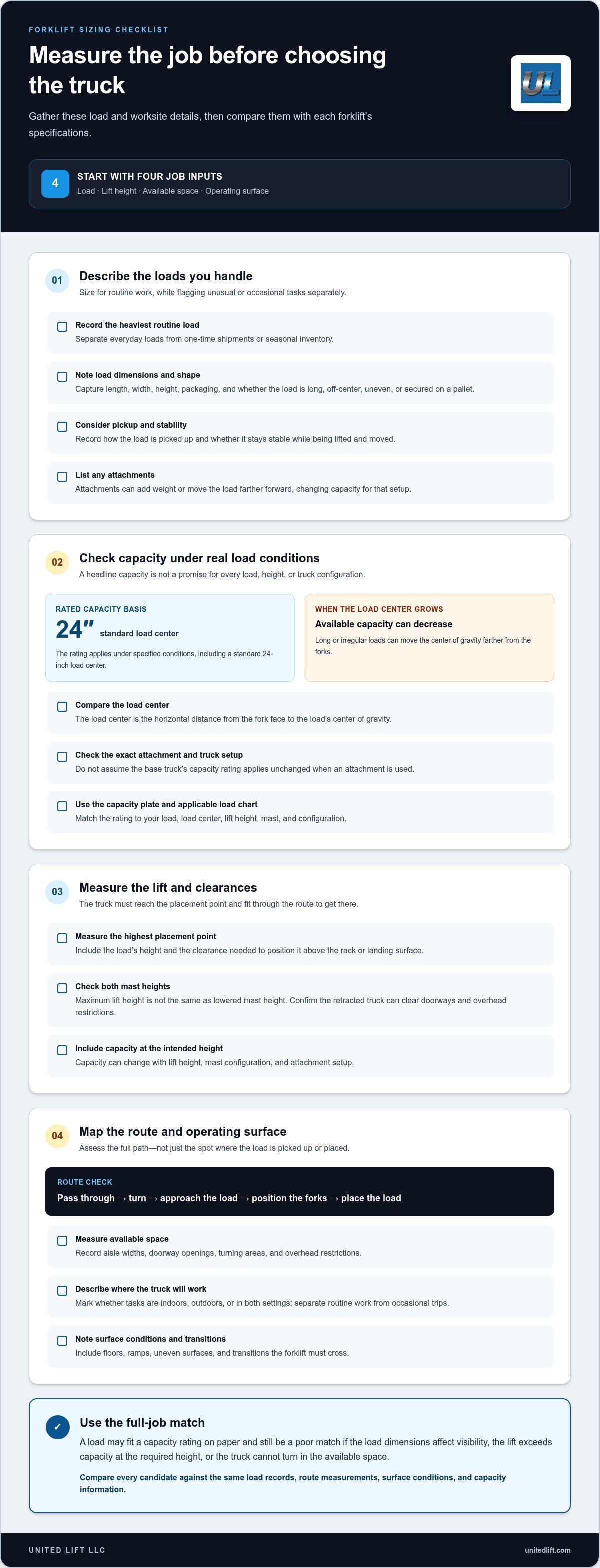
Use This Forklift Sizing Checklist Before You Choose
A clear checklist turns “what size forklift do I need” into a practical equipment comparison. Gather the same load and site information for every candidate, then check it against each machine’s documentation. This makes it easier to rule out a poor fit before comparing brands, models, or new and pre-owned options.
What measurements and operating details should you collect?
Build one worksheet for the tasks the forklift will perform. Use measurements from actual loads and travel routes, and distinguish routine needs from occasional ones. Include attachments in your notes because they can affect the capacity available for a specific configuration. Keep the information together to compare candidate machines consistently.
- Record the loads. Note typical and heaviest routine weights, load dimensions, packaging, shape, and handling frequency. Flag unusual or occasional loads separately.
- Document attachments. List the attachment used for each task and review its effect on capacity using the applicable equipment documentation.
- Measure lift requirements. Record the highest rack or placement point, load height, positioning clearance, and overhead restrictions.
- Map the travel route. Measure the narrowest aisle, doorways, access openings, and turning points from pickup through delivery.
- Describe the operating surface. Mark indoor and outdoor sections, floor conditions, slopes, surface changes, and areas where turning or positioning is required.
How do you turn the checklist into a shortlist?
Check each candidate against its model-specific capacity information, load chart, lift-height details, and dimensions. Don’t rely on nominal capacity alone. A machine that misses a required clearance or can’t meet the lift condition isn’t suitable for that task, even if its headline capacity looks right.
- Remove hard mismatches. Set aside options that fail a required load, lift-height, doorway, aisle, or overhead-clearance condition.
- Compare workable candidates. Assess the remaining machines for maneuverability with your actual loads, route demands, and operating surfaces.
- Separate regular and occasional work. Identify whether one machine suits routine tasks or whether an uncommon requirement calls for a different equipment solution.
- Review the purchase decision. Once the job fit is clear, compare new and pre-owned options and consider factors such as condition and ownership needs. A forklift buying guide can help structure that comparison.
Keep your checklist beside the equipment specifications as you narrow the field. United Lift offers new and pre-owned forklifts from brands including Hyster, Yale, Toyota, and Caterpillar. Explore forklift options for your work and build a shortlist around verified job requirements.
Choose a Forklift That Fits the Job and Your Next Step
The right forklift meets your operating requirements as a complete set. Load weight and dimensions affect capacity; lift height and load position affect the lift; truck dimensions and turning space affect access; and the work surface helps define where the machine can operate. A suitable choice meets every essential requirement, not just the capacity listed in a product description.
Once you’ve defined the job, compare models across brands and decide whether new or pre-owned equipment better suits your operation. Keep your measurements and task priorities in front of you. They’ll help you compare equipment on fit instead of choosing by brand name or headline capacity alone.
When should you compare different forklift options?
Compare options after identifying the required capacity, lift height, and route clearances. If more than one model meets those needs, compare maneuverability, work conditions, and how often the truck will perform each task. Include forklifts from Hyster, Yale, Toyota, and Caterpillar in your shortlist, then assess each against the same job requirements.
Consider new and pre-owned equipment in light of your operation’s priorities and expected use. The right comparison depends on the job and the equipment’s fit, not on assuming one purchase path works best for every operation. Financing can also be part of the purchase discussion as you weigh suitable options.
What should you have ready when discussing your requirements?
Bring the details that make the job specific. An organized summary gives the equipment discussion a clear starting point and keeps candidate forklifts tied to the actual work. Include routine tasks and less frequent requirements so your shortlist reflects how the truck will be used.
- Load details: typical and heaviest weights, dimensions, packaging, frequency, and any unusual load shape.
- Lift requirements: highest placement point, load height, and clearance needed to position the load.
- Site measurements: aisle widths, door and access openings, overhead restrictions, turning points, and travel route.
- Work conditions: indoor or outdoor use, surface conditions, and transitions along the route.
- Equipment needs: attachments required and whether you’re considering new or pre-owned equipment.
With those details in hand, discuss forklift options and financing with United Lift’s phone or email support. United Lift offers new and pre-owned forklifts from major brands, including Hyster, Yale, Toyota, and Caterpillar. Explore United Lift forklift options and bring your job requirements to the conversation. A clear specification list keeps the focus on machines that match your loads, space, lift needs, and operating conditions.
Turn Your Sizing Notes Into a Confident Choice
Your sizing worksheet can guide future equipment decisions, too. Keep it as a working reference for changes such as new load types, revised storage layouts, or a different travel route. If the job changes, revisit the requirements before assuming the current forklift is still the right fit.
Still asking, “what size forklift do I need?” Use your documented requirements to compare suitable options, then focus on models that match your operation rather than choosing by capacity alone. A clear job profile gives you a practical starting point for evaluating equipment and purchase options.
United Lift offers forklifts from brands including Hyster, Yale, Toyota, and Caterpillar, with new and pre-owned options, financing, and phone and email support seven days a week. Explore United Lift’s forklift options and use your sizing notes to take the next step. The right comparison starts with the work you need done.
Frequently Asked Questions
What size forklift do I need for a 5,000-pound load?
Choose a forklift whose rated capacity covers a 5,000-pound load under your actual load-center, lift-height, and attachment conditions. A 5,000-pound capacity label alone doesn’t confirm that the machine can handle your particular load. Check the capacity plate and applicable load chart for the exact configuration. If the load is unusually long or you use an attachment, the allowable capacity may be lower, so don’t assume a truck rated at exactly 5,000 pounds is suitable.
How do I calculate the forklift capacity I need?
Start with the heaviest load you expect the forklift to handle, then record its dimensions and how it sits on the forks. Include the required lift height and any attachment. Use those details to check the capacity plate and model-specific load chart, which show limits under the machine’s specified conditions. There isn’t one reliable calculation based on weight alone. If the chart doesn’t clearly cover your load and setup, don’t estimate a safe capacity by guesswork.
How much aisle space does a forklift need?
The required aisle space depends on the specific forklift, the load, and the turn or placement maneuver. Measure the clear usable width, including posts, stored items, and other obstructions that reduce the passage. Then check whether the truck can turn and align with the rack while carrying the load. Compare your measurements with the manufacturer’s aisle guidance for the exact model and task instead of relying on the aisle’s nominal design width.
What forklift size do I need to reach a specific lift height?
Choose a forklift that can place the forks at the required height while handling your load in that configuration. Measure to the actual placement point, including the clearance needed to position the load. Then check the model’s lift-height information and capacity chart at that height. Also compare the lowered machine height with overhead limits along the route. A forklift’s maximum lift height alone doesn’t confirm it can safely lift your load that high.
Can a forklift lift more than its rated capacity?
No. Don’t lift beyond the capacity permitted for the forklift’s current configuration and task. Load position, height, and attachments can affect the applicable limit, so the number on a general product description may not represent the capacity for every lift. Check the capacity plate and relevant load chart before operating. If the load exceeds the limit shown for the setup, use equipment rated for that task instead of attempting the lift or adding improvised counterweight.
What size forklift is best for a warehouse?
There’s no single best size for every warehouse. A site with fixed racks and tight turns may prioritize a smaller maneuvering footprint, while frequent dock or staging work may call for different dimensions and travel access. Compare candidate forklifts against your storage layout, pallet-handling tasks, floor conditions, and overhead clearances. The best fit handles your routine work and moves through the actual warehouse route while meeting capacity requirements.
Should I choose a different forklift size for outdoor work?
Possibly. Outdoor routes can involve different surface conditions, slopes, and transitions than indoor floors, so assess the full travel path rather than choosing by load capacity alone. Compare the forklift’s stated operating requirements with the ground conditions, space to turn, and access back into the building. If one machine must work both indoors and outdoors, check that its dimensions and operating specifications suit both settings and the loads it will handle.
- Tags: equipment guide, forklift capacity, forklift sizing, forklifts, material handling, warehouse equipment, warehouse management, what size forklift do I need
