
Best Forklift for Container Loading: 2026 Buyer's Guide
Posted by United Lift LLC on
If your forklift's mast is even an inch too tall, your shipping container becomes a steel-walled trap for a very expensive piece of equipment. You likely already know the stress of watching a mast get dangerously close to a container ceiling or managing thick fumes in a confined space. It's a high-stakes environment where the wrong specifications lead to damaged goods, stalled productivity, or safety risks. Finding the best forklift for shipping container loading isn't just about total lift capacity; it's about precision dimensions and specialized mast technology.
We've designed this 2026 buyer's guide to help you navigate these challenges with confidence. You'll discover why a collapsed mast height of 2.28m or less is the critical spec for standard containers and how "full free lift" masts allow you to stack high without hitting the roof. With electric models now representing 69% of market demand, we'll also compare the latest lithium-ion units against traditional LP gas options. We will preview the top 2026 models from brands like Toyota and Hyster while providing a clear path to securing reliable equipment through national financing options.
Key Takeaways
- Avoid the "container squeeze" by prioritizing collapsed mast height over maximum lift capacity to ensure safe entry.
- Discover why cushion tires and a 3,000 to 5,000 lb capacity range are the gold standard for navigating tight container quarters.
- Compare electric and LP gas models to find the best forklift for shipping container loading that protects your air quality and uptime.
- Review specialized container-spec configurations from industry leaders like Toyota, Hyster, and Yale.
- Learn how to balance new versus used inventory while utilizing national financing options to grow your fleet.
Why Standard Forklifts Fail in Shipping Containers
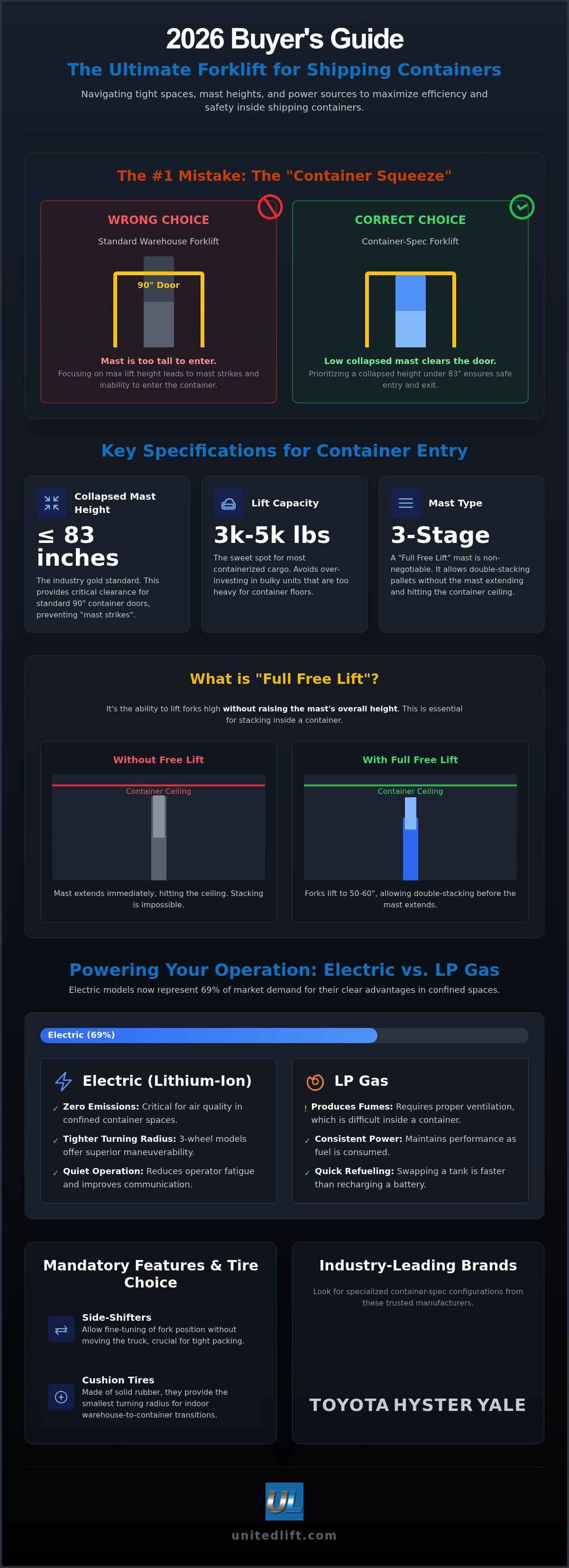
Standard warehouse forklifts are built for high-reach racking, not the cramped interior of a shipping container. Most standard ISO containers have a door height of roughly 90 inches. If you try to drive a standard unit inside, you'll experience what we call the "Container Squeeze." The #1 mistake buyers make is selecting a machine based on maximum lift height instead of collapsed height. While you need that reach in the warehouse, the machine won't even make it through the container threshold if the mast is too tall. Beyond the mast, you must also consider the overhead guard height. It needs to be low enough to clear the ceiling while still providing full protection for the operator. Understanding Forklift basics helps you realize that specialized mast configurations are required for this specific task. Finding the best forklift for shipping container duty means balancing these tight tolerances.
The Critical Role of Full Free Lift
Free lift is the distance the forks move before the mast extends. In a container, you don't have vertical room for the mast to grow. You need a "full free lift" mast, typically a three-stage version. This setup allows you to lift a pallet high enough to double-stack without the inner mast rails punching through the container roof. For most operations, you'll want at least 50 to 60 inches of free lift. Without it, you're stuck with single-layer loading. This effectively doubles your shipping costs because you can't utilize the upper half of the container space. If your business depends on maximizing cube utilization, a three-stage mast is non-negotiable.
Collapsed Mast Height vs. Door Clearance
Door clearance is your first hurdle. A standard container door is about 8 feet tall, while a High Cube offers 9 feet 6 inches. However, you can't cut it close. A collapsed mast height of 83 inches or less is the industry gold standard for the best forklift for shipping container work. This provides enough clearance to account for the transition from the loading dock or yard ramp into the box. If your mast is too high, you risk a "mast strike" when backing out. This isn't just a maintenance headache; it's a structural safety risk for the container and the operator. It's better to have a few inches of breathing room than a damaged mast or a dented container roof.
Essential Specifications for Container-Entry Forklifts
Most containerized cargo falls within a 3,000 to 5,000 lb weight range. Choosing a machine with this specific capacity ensures you aren't over-investing in a bulky unit that won't fit through the door. However, capacity isn't the only weight factor. You must verify that the combined weight of the forklift and its load doesn't exceed the container floor's rated capacity. Standard containers can be fragile; a heavy machine can literally fall through the floor boards. Always check your dock leveler ratings before starting the job. Adhering to OSHA container handling regulations is vital for maintaining a safe workspace during these transitions. If you need a machine that hits these exact specs, you can browse our container-spec inventory to find a reliable match.
Precision is everything when you're working with only a few inches of clearance on either side. Side-shifters are mandatory for this kind of work. They allow the operator to shift the load carriage left or right without repositioning the entire truck. This reduces the number of movements needed inside the box, which saves time and significantly lowers the risk of hitting the corrugated steel walls. Without a side-shifter, you'll find it nearly impossible to get pallets flush against the walls for a tight, secure load.
Maneuverability and Turning Radius
Three-wheel electric forklifts are often the best forklift for shipping container tasks. Their unique pivot point allows for a much tighter turning radius compared to traditional four-wheel models. A shorter wheelbase is also helpful. It prevents the "belly" of the machine from bottoming out as you cross the incline of a dock plate. Compact chassis designs are specifically engineered for these tight staging areas. They allow operators to make sharp U-turns in narrow aisles right before entering the box. A machine that can turn within its own footprint will always outperform a larger, more cumbersome unit in a loading dock environment.
Tire Selection for Smooth Transitions
Tire choice dictates how well your machine handles the transition from the warehouse floor to the container interior. Cushion tires are the standard for indoor use. They are made of solid rubber pressed onto a steel band. This design offers the smallest possible turning radius and excellent stability on flat surfaces. If your facility has sensitive or high-gloss floors, non-marking tires prevent unsightly black scuffs. For operations that move between gravel yards and steel containers, solid pneumatic tires are the only compromise. They won't go flat, yet they provide enough traction for outdoor inclines. Selecting the right tire is a key step in identifying the best forklift for shipping container efficiency and safety.
Powering Your Operation: Electric vs. LP Gas
Choosing the right power source is a balancing act between safety and operational uptime. In a 40-foot steel box, air quality is your biggest concern. Internal combustion engines emit carbon monoxide that can reach dangerous levels in minutes within such a confined space. This is why many logistics managers believe an electric model is the best forklift for shipping container loading. Beyond safety, you have to look at the total cost of ownership. Electric units typically cost more upfront. However, they have fewer moving parts, which leads to lower maintenance expenses over a five-year period. The role of containerization has evolved to demand higher efficiency, and your power choice directly impacts your bottom line.
While electric is gaining ground, the decision often hinges on your existing infrastructure. Do you have the electrical capacity for charging stations, or is a propane cage more feasible? Evaluating the initial cost against long-term ROI is essential. Electric motors don't require oil changes, spark plugs, or air filters, which simplifies your service schedule. Finding the best forklift for shipping container work requires looking past the sticker price to see the true cost per hour of operation.
Electric Forklifts: The Indoor Standard
Zero emissions are the primary advantage here. You can work at the nose of a container for hours without worrying about exhaust buildup or operator fatigue from fumes. Electric motors are also significantly quieter than their gas counterparts. This improves communication between the operator and dock workers, which is vital for safety in tight quarters. In 2026, the shift toward Lithium-Ion batteries has removed the old charging downtime hurdle. With opportunity charging, you can top off the battery during a 15-minute break. This technology is a major reason why electric models now hold a 69% share of the global market.
LP Gas (Propane): The High-Intensity Alternative
LP gas remains a popular choice for high-intensity, multi-shift operations. A propane tank provides consistent power from start to finish. There is no performance drop-off as the fuel runs low. Refueling is as simple as swapping a tank, which takes less than two minutes. This is a clear advantage for operations that don't have the luxury of charging windows. However, if you choose LP gas, you must implement strict ventilation protocols. High-powered fans are necessary to cycle fresh air into the container. While these units are versatile, you must weigh the refueling speed against the ongoing costs of fuel and engine maintenance.
Top Forklift Brands for Container Handling
Selecting the best forklift for shipping container operations often comes down to brand-specific engineering. Hyster and Yale are legendary for their robust chassis designs. Their LP gas series, specifically the Hyster Fortis and Yale Veracitor, are built to withstand the high heat and heavy vibrations of constant container loading. If you're leaning toward electric, their compact lines are perfect for low-clearance tasks where every inch matters. These brands are often preferred for heavy-duty industrial cycles because they don't quit when the shift gets long.
Hyster and Yale Container Solutions
These manufacturers offer specialized "container-spec" configurations straight from the factory. This means you get a lower overhead guard and a triple-stage mast with full free lift as standard equipment. These features are essential for the tight tolerances we discussed earlier. For more insights on how these brands fit into your broader facility strategy, check out The Ultimate Forklift Buying Guide for Industrial Success in 2026. Whether you need a new Hyster or a pre-owned Yale, these machines provide the durability required for high-volume logistics.
Toyota and Caterpillar Reliability
Toyota remains an industry leader because of its focus on safety and ergonomics. Their System of Active Stability (SAS) is a game-changer for ramp transitions. It electronically monitors the truck's operation to help reduce the risk of tip-overs when moving between the dock and the container. Caterpillar (CAT) takes a different but equally valuable approach by focusing on operator visibility. Their mast designs are engineered to provide a clear line of sight, which is critical when you're maneuvering in a dark, narrow steel box. Both brands are durable options for high-cycle loading environments where uptime is the only metric that matters.
You don't always need to buy brand new to get premium performance. Finding the best forklift for shipping container loading doesn't have to break your budget if you choose a certified pre-owned unit. Evaluating used inventory is a smart way to find value in these top-tier brands. A pre-owned Toyota or CAT with 3,000 to 5,000 hours still has plenty of life for a container operation. At United Lift, we specialize in both new and pre-owned models from these major manufacturers. If you're ready to upgrade your fleet, contact our team to see our current inventory of container-ready forklifts.
Securing the Right Equipment for Your Logistics Chain
Deciding between new and pre-owned machinery is one of the most important choices you'll make for your fleet. New equipment offers the latest 2026 technology and the peace of mind that comes with factory warranties. However, a high-quality used unit often provides the best forklift for shipping container tasks when you need to manage capital outlay. We maintain a deep national inventory of pre-owned premium brands that are ready for immediate deployment. This availability is a huge advantage when you can't afford to wait for long factory lead times. Our team provides support seven days a week to ensure your operation never skips a beat.
Smart financial planning can significantly lower the net cost of your equipment purchase this year. You should leverage Section 179 tax deductions to maximize your 2026 budget. This incentive allows businesses to deduct the full purchase price of qualifying equipment from their gross income in the year it's put into service. It's a powerful tool for industrial fleets looking to modernize or expand. We recommend consulting with your tax professional to confirm the specific limits and eligibility for your business before the year ends.
Financing Your Forklift Purchase
United Lift LLC simplifies the equipment loan process so you can focus on moving cargo. We facilitate national financing and leasing options tailored to your specific business requirements. Small businesses often find our flexible terms helpful for managing cash flow while growing their industrial fleets. If your operation involves high-usage container loading, leasing might be the better path. It allows you to cycle in fresh equipment every few years without the long-term responsibilities of ownership. We act as a reliable facilitator to help you find the right balance between equity and monthly costs.
Maximizing Your Investment with Attachments
The right machine is only the foundation of a productive dock. You also need specialized equipment attachments to handle diverse cargo types efficiently. Side-shifters and fork positioners are essential for container work because they allow for the precision placement we discussed in earlier sections. If you've transitioned to an electric fleet, investing in high-capacity industrial batteries is your next priority. These ensure your machines stay powered through demanding multi-shift operations. We offer both economy and premium solutions to help you build the best forklift for shipping container duty. Ready to find your next machine? Contact United Lift LLC today to browse our container-spec inventory.
Upgrade Your Container Loading Efficiency Today
Choosing the right equipment is the difference between a seamless logistics chain and a bottleneck at the dock. You now know that identifying the best forklift for shipping container duty requires focusing on collapsed mast height and full free lift capabilities. Whether you opt for the zero-emission efficiency of a modern electric unit or the consistent power of LP gas, your choice should prioritize operator safety and cube utilization. These technical details ensure you can double-stack pallets without risking damage to the container roof or the machine itself.
United Lift is ready to help you navigate these specifications with expert guidance and a massive national inventory. We carry top-tier brands like Hyster, Yale, and Toyota, ensuring you have access to the most reliable machinery on the market. Our team provides expert financing for industrial equipment to make your 2026 acquisition as smooth as possible. With support available 7 days a week, we're here to ensure your fleet stays in motion and your deadlines are met.
Ready to optimize your warehouse? Find Your Next Container-Spec Forklift at United Lift and take the next step toward a more efficient and profitable operation.
Frequently Asked Questions
What is the standard mast height for a container forklift?
The industry standard for a container-spec forklift is a collapsed mast height of 83 inches or less. This dimension provides enough clearance to safely navigate through a standard 90-inch container door. Always verify this measurement before purchasing. Even a slight incline on a loading ramp can reduce your effective clearance. This breathing room prevents dangerous mast strikes and protects both your equipment and the container roof.
Can I use an internal combustion forklift inside a shipping container?
You can use an internal combustion forklift inside a container, but you must prioritize high-volume ventilation. Propane engines emit carbon monoxide which builds up quickly in a 40-foot steel box. For many logistics managers, the best forklift for shipping container loading is an electric model. It eliminates these air quality risks and the need for external fans, making it a safer choice for enclosed spaces.
What is "free lift" and why is it important for loading?
Free lift is the distance the forks can rise before the inner mast rails begin to extend upward. It is essential for container work because it allows you to lift a pallet to a second tier without the mast punching through the container roof. Most container-ready units feature a triple-stage mast to maximize this specific capability. Without sufficient free lift, you won't be able to utilize the container's upper vertical space.
Will a 5,000 lb capacity forklift fit inside a standard ISO container?
A 5,000 lb capacity forklift will typically fit inside a standard ISO container, provided it features a compact chassis. You must check that the machine's overall width and overhead guard height are compatible with the container's interior dimensions. These machines are the industry standard for most palletized freight. They offer the necessary muscle to move heavy loads while remaining agile enough to maneuver within the narrow steel walls.
What are the benefits of cushion tires for container loading?
Cushion tires offer a tighter turning radius and increased stability on the flat steel floors of a shipping container. They are made of solid rubber pressed onto a steel band, which results in a smaller overall tire diameter. This compact design allows the forklift to make sharper turns in narrow staging areas. They are the ideal choice for indoor applications where floor space is at a premium.
How does Section 179 apply to my forklift purchase in 2026?
Section 179 allows your business to deduct the entire purchase price of a new or used forklift from your 2026 gross income. This tax incentive is designed to encourage equipment investment by providing immediate tax relief rather than depreciating the asset over several years. It is an effective way to lower the net cost of upgrading your fleet. Consult your tax professional to confirm the current 2026 limits.
Do I need a three-wheel or four-wheel forklift for container work?
Three-wheel forklifts are generally better for container work due to their superior maneuverability and tighter pivot points. They excel at making the sharp turns required to place pallets flush against container walls. However, if you are frequently navigating steep yard ramps or handling loads at the top end of the 5,000 lb range, a four-wheel model may offer more stability. The choice depends on your specific dock environment.
What is the difference between a standard container and a High Cube for forklift entry?
A standard ISO container is 8 feet 6 inches tall with a door opening of approximately 90 inches. In contrast, a High Cube container is 9 feet 6 inches tall, providing an extra foot of vertical clearance. While High Cubes are more forgiving, the best forklift for shipping container operations should still meet the 83-inch collapsed height standard. This ensures your equipment remains compatible with every container that arrives at your dock.
- Tags: best forklift for shipping container, buyer's guide, container loading, electric forklifts, forklift safety, forklifts, low mast forklift, material handling, shipping containers
