
Best Narrow Aisle Forklifts: 2026 Warehouse Guide
Posted by United Lift LLC on
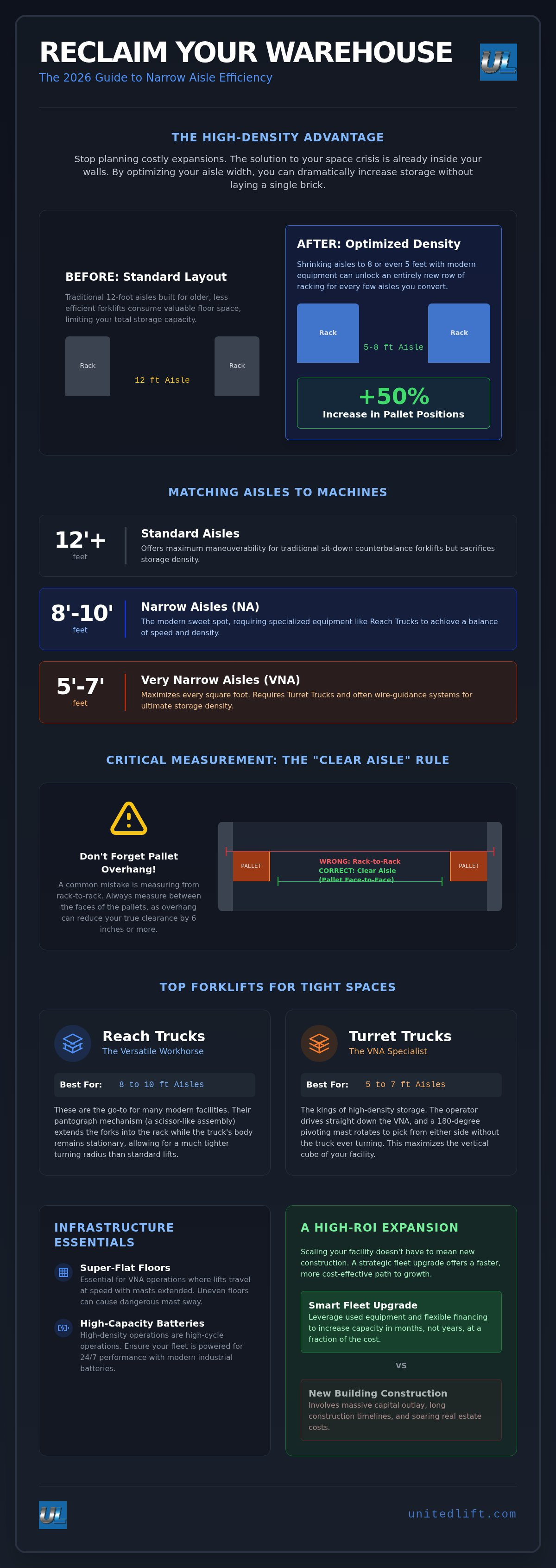
Why spend millions on a warehouse expansion when you could just reclaim the space you already own? Most operations managers feel the constant pressure of a maxed-out floor plan, yet many are still running 12-foot aisles designed for decades-old technology. Finding the best forklift for narrow aisles isn't just about buying a smaller machine. It's about a calculated strategy to increase your pallet positions by up to 50 percent without moving a single exterior wall.
We know that cramped quarters often lead to operator fatigue and slower pick times. It's a frustrating trade-off between storage density and operational speed. This 2026 guide will show you exactly how to balance those needs by selecting equipment tailored to your specific rack dimensions. We'll look at the latest reach trucks and turret models, explain how to navigate the newest OSHA behavioral monitoring requirements, and show you how smart financing can make a fleet upgrade more cost-effective than a building expansion.
Key Takeaways
- Reclaiming warehouse space starts with the math. Learn how shrinking aisles from 12 feet down to 8 or 5 feet can increase your storage capacity by up to 50 percent.
- Matching the machine to the rack. We'll help you identify the best forklift for narrow aisles by comparing turning radii and mast stability across top-tier brands.
- Reach trucks vs. order pickers. Understand when to prioritize full-pallet movement over individual case picking to keep your pickers moving at peak efficiency.
- Infrastructure essentials. Discover why super-flat floors and high-capacity industrial batteries are non-negotiable for high-density, 24/7 warehouse operations.
- High-ROI expansion. See how leveraging the used equipment market and flexible financing can help you scale your facility without the cost of new construction.
Understanding Warehouse Aisle Dimensions: Standard vs. Narrow vs. VNA
Warehouse space is a premium asset. In 2026, every square foot is a line item that impacts your bottom line. If you're still running aisles wider than 12 feet, you're likely leaving money on the table. Choosing the right equipment starts with understanding the three main categories of warehouse spacing and how they dictate your fleet needs.
- Standard Aisles (12+ feet): These are built for the traditional sit-down counterbalance Forklift. They offer plenty of room for high-speed travel but sacrifice storage density for maneuvering ease.
- Narrow Aisles (8 to 10 feet): This is the sweet spot for many modern facilities. These aisles require specialized equipment like reach trucks or stand-up counterbalance models to turn within the tight radius.
- Very Narrow Aisles (VNA) (5 to 7 feet): These maximize storage by shrinking the aisle to the bare minimum. You'll need turret trucks or specialized order pickers that don't need to turn the entire chassis to face the rack.
Don't fall into the trap of measuring rack-to-rack. You must follow the "Clear Aisle" rule. This means measuring the space between pallet faces, not the steel uprights. Standard pallets often overhang the rack by 2 or 3 inches. If you forget to account for that 6-inch total loss, your operators won't have the clearance they need to turn safely. It's a small detail that can lead to significant rack damage over time.
Calculating Your Required Aisle Width
Finding the best forklift for narrow aisles requires a bit of math. Start with the manufacturer's specified basic turning radius for the machine. Then, add the length of your pallet and an additional 12 inches for a "comfort" clearance. This buffer helps prevent rack strikes and speeds up cycle times. You also need to factor in mast sway. When lifting heavy loads to the top beam, the mast can flex slightly. If your aisles are too tight, that sway can cause the load to clip the opposite rack during the lift. Always check the stability ratings for your specific lift height before you finalize your aisle width.
Why Aisle Density Matters for 2026 Logistics
Industrial real estate costs continue to climb, making vertical storage a necessity rather than an option. Shrinking your aisles by just 20 percent can often increase your total pallet positions by up to 50 percent. This happens because those extra inches saved in every aisle eventually add up to an entirely new row of racking. Beyond storage, tighter aisles reduce the travel distance for your team. When pickers spend less time driving and more time picking, your order fulfillment speed naturally increases. It's a hardware-based solution to a labor-intensive problem that helps you scale without moving to a larger facility.
The Top 4 Forklift Types for Tight Spaces
Once you've mapped out your aisle math, the next step is choosing the hardware that fits those specific dimensions. Determining the best forklift for narrow aisles involves looking at your load types and vertical requirements. While the "Clear Aisle" rule gives you the boundaries, the chassis design of these four machines determines how efficiently you can navigate them. Each model offers a different solution for balancing storage density with operational speed.
Reach Trucks: The Versatile Workhorse
Reach trucks are the go-to solution for aisles between 8 and 10 feet wide. These machines use a pantograph mechanism, which is a scissor-like assembly that allows the forks to extend deep into the racking while the truck stays stationary. This design eliminates the need for the large counterweight found on standard lifts. Instead, they rely on stabilizing outriggers. This makes the machine much shorter and tighter in its turning radius. Leading brands like Hyster and Yale have perfected these high-cycle units for heavy use. To see how these models compare, you can browse our current inventory of reach trucks at United Lift LLC to find a match for your facility.
Turret Trucks and Swing-Reach Technology
Turret trucks are the specialized kings of Very Narrow Aisle (VNA) layouts. When your aisles shrink to 5 or 7 feet, there isn't enough room for a reach truck to turn and face the rack. Turret trucks solve this with a 180-degree pivoting mast. The operator drives straight down the aisle and simply rotates the head to pick from either side. Because these aisles are so tight, these trucks often run on wire or rail guidance systems to prevent steering errors. It's a significant investment in technology, but it's the most effective way to maximize your vertical cube without expanding your building's footprint.
Order pickers serve a different role than pallet movers. These are man-up machines where the operator platform rises with the forks. This allows your team to pick individual cases or small items directly from the shelves at heights that can exceed 30 feet. Since the operator is working at height, you must follow OSHA safety guidelines for narrow aisles, which include strict fall protection and floor maintenance. They don't move full pallets efficiently, but they're essential for high-volume e-commerce fulfillment.
For operations that need a flexible hybrid, the stand-up counterbalance forklift is a strong contender. These units are much shorter than traditional sit-down models. They don't have the reach of a pantograph truck, but they can turn comfortably in 10-foot aisles and still work on a loading dock. This "dock-to-stock" capability makes them a favorite for smaller warehouses that don't want to maintain two different types of equipment for unloading trailers and putting away inventory.
Reach Trucks vs. Order Pickers: Which One Does Your Facility Need?
Don't confuse these two machines just because they both operate in tight spaces. Choosing the best forklift for narrow aisles requires a deep look at your specific fulfillment process. While they might look similar from a distance, they serve completely different operational roles. One is built for moving heavy loads; the other is built for moving people. Understanding the difference is the key to hitting your daily throughput targets.
The primary distinction lies in functionality and operator position. Reach trucks are designed for moving full pallets from point A to point B. The operator stays at ground level while the mast does the work. In contrast, order pickers are "man-up" machines. The operator platform rises with the forks, allowing the team member to hand-pick individual cases or items directly from the rack. This makes the order picker a specialized tool for e-commerce, while the reach truck remains the backbone of general pallet storage.
Efficiency metrics also vary between the two. When evaluating a reach truck, you should measure success in pallets per hour. It's about how quickly you can put away a shipment or stage a trailer. For order pickers, the gold standard is picks per hour. If your facility focuses on broken-case picking or small-parcel shipping, a reach truck will actually slow you down. You need a machine that puts the operator right at the inventory face.
When to Choose a Reach Truck
Reach trucks are the right investment if your warehouse handles high-volume pallet storage and retrieval. They excel in environments with uniform pallet sizes and deep racking systems. Because the operator remains on the ground, cycle times for full pallet movements are significantly faster. If you're still weighing your options for a full fleet overhaul, check out The Ultimate Forklift Buying Guide for a deeper dive into industrial success strategies. These machines are the workhorses of the 8 to 10-foot aisle, providing the stability needed for heavy lifts at significant heights.
When to Invest in Order Pickers
Order pickers are essential for retail fulfillment centers where case picking is the priority. These machines allow operators to reach inventory at heights of 30 feet or more. This verticality lets you use every inch of your warehouse's "cube" for active picking. Safety is the top priority here. Because the operator is elevated, 2026 OSHA regulations require strict adherence to fall protection protocols. This includes the use of body harnesses and self-retracting lifelines. While the equipment cost is a factor, the ability to access thousands of SKUs without bringing down entire pallets is a massive efficiency gain for modern logistics.
Key Considerations Before Shrinking Your Aisles
Shrinking your aisle widths is a high-stakes decision that involves more than just equipment. While the best forklift for narrow aisles can handle tight corners, your warehouse environment must support that machine. You can't just narrow the racks and hope for the best. You need to audit your facility's physical infrastructure and safety protocols first to ensure your investment actually pays off.
The Importance of Floor Levelness
Floor quality is often the invisible dealbreaker for Very Narrow Aisle (VNA) systems. When you're lifting a heavy pallet 30 feet into the air, stability is everything. A tiny floor deviation of just 1/8 inch at the base translates to several inches of mast sway at full height. This lean can cause the load to strike the rack or create a tip-over risk. While floor grinding is an option to fix dips, choosing a lift with high-quality cushion tires provides a more stable foundation for indoor work. If your floor isn't perfectly flat, a more forgiving reach truck might be a safer bet than a rigid turret model.
Powering Your Narrow Aisle Fleet
Electric power is the non-negotiable standard for indoor narrow aisle work. You have two main choices for industrial batteries: traditional lead-acid or modern lithium-ion. Lead-acid is cost-effective for single-shift operations but requires dedicated charging rooms. Lithium-ion is the 2026 favorite for 24/7 operations because it supports opportunity charging during breaks. This eliminates the need for battery swaps and keeps your fleet moving. We stock a wide variety of high-performance industrial batteries at United Lift LLC to ensure your narrow aisle equipment never loses momentum during a busy shift.
Don't overlook the human element and regulatory compliance. The OSHA National Emphasis Program on Warehousing is active through mid-2026. Inspectors are looking for more than just a one-time certification. The 2026 revisions to OSHA guidance emphasize continuous behavioral verification. You need documented evidence that your operators can handle specialized equipment in your specific warehouse conditions. With maximum penalties for serious violations reaching $16,550, implementing telematics and impact sensors is a smart way to monitor performance. These systems provide the digital, timestamped records that OSHA now expects during unannounced inspections in tight environments.
Finding and Financing the Right Narrow Aisle Equipment
Acquiring the right fleet is the final piece of the warehouse density puzzle. High-density storage is a major capital investment. Whether you're looking for the best forklift for narrow aisles to fit a new VNA layout or replacing an aging reach truck, the acquisition method matters as much as the machine's specs. You need a partner who understands the nuances of material handling finance and can source equipment that meets 2026 safety standards without the long lead times often associated with new factory orders.
New vs. Pre-Owned Narrow Aisle Lifts
The used market is often the smartest route for specialized VNA hardware. New turret trucks and reach trucks carry significant price tags. Pre-owned units from reliable brands like Hyster, Yale, and Toyota offer a high-ROI alternative that gets your warehouse operational faster. When evaluating used equipment, pay close attention to mast wear and hydraulic seals. These components work harder in narrow aisle environments than in standard applications because they spend more time at full extension. We stock a variety of both economy and premium pre-owned solutions to fit different budget levels and duty cycles, ensuring you get a reliable machine that fits your specific aisle math.
Financing Your Warehouse Expansion
Preserving business cash flow is essential when you're scaling. Equipment financing allows you to spread the cost of your fleet over several years rather than taking a massive hit to your capital reserves. In August 2026, market rates for established businesses with good credit typically range between 6 percent and 9 percent APR. For startups or those with challenged credit, rates may range from the mid-teens to 25 percent. Beyond just the monthly payment, heavy machinery purchases often qualify for Section 179 tax deductions. This allows you to deduct the full purchase price of the equipment in the year it's put into service, even if you finance it. It's a powerful tool for turning a tax liability into warehouse hardware.
United Lift LLC acts as a national facilitator for these transactions. We provide national shipping and support seven days a week to ensure your operations never stall. Our team specializes in in-house financing facilitation for capital equipment, making the path from identifying a need to receiving a delivery seamless. We understand the urgency of the material handling industry and value your time. If you're ready to reclaim your warehouse space and identify the right equipment for your facility, contact United Lift LLC today for a custom financing quote.
Ready to Reclaim Your Warehouse Floor?
Maximizing your storage density in 2026 isn't just about moving racks closer together. It's about a strategic alignment between your floor quality, your picking needs, and your equipment choices. We've seen how the right aisle math and specialized battery tech can transform a cramped facility into a high-throughput powerhouse. Whether you're transitioning to a VNA layout or simply upgrading your reach trucks, the best forklift for narrow aisles is the one that balances your specific operational goals with long-term ROI.
United Lift is here to help you navigate these choices with confidence. We offer national shipping on all Hyster, Yale, and Toyota models to keep your facility running at peak capacity. Our team provides expert support seven days a week and facilitates financing options for both new and used equipment. Don't let a lack of space stall your growth. Browse Our Current Inventory of Narrow Aisle Forklifts and find the hardware that fits your warehouse today. Your next stage of expansion is just one fleet upgrade away.
Frequently Asked Questions
What is the minimum aisle width for a reach truck?
A reach truck typically requires a minimum aisle width of 8 to 10 feet to operate safely. This measurement must account for the length of your pallet and a 12-inch clearance buffer to prevent rack strikes. While the machine is compact, the turning radius remains the deciding factor for your specific layout.
Can a standard counterbalance forklift work in narrow aisles?
A standard sit-down counterbalance forklift generally cannot work in narrow aisles because it requires at least 12 feet of clearance to turn. Attempting to force a standard lift into a 10-foot space often leads to significant rack damage and safety risks. If your aisles are under 12 feet, you'll need to invest in specialized narrow aisle equipment.
What is a VNA forklift?
A VNA forklift is a "Very Narrow Aisle" machine designed to work in spaces as tight as 5 to 7 feet. These units, such as turret trucks, use a pivoting mast to pick loads from either side of the aisle without turning the chassis. This technology is the best forklift for narrow aisles when your goal is maximum storage density.
Do I need a special license for a turret truck?
OSHA requires a site-specific performance evaluation for any operator using specialized equipment like a turret truck. While there isn't a separate federal "license" just for VNAs, your 2026 compliance records must show that operators were trained on that exact model in your specific warehouse conditions. A general forklift certification isn't sufficient for these complex machines.
How much more can I store by switching to narrow aisles?
Switching from standard to narrow aisles can increase your total pallet positions by up to 50 percent. By shrinking 12-foot aisles down to 8 or 9 feet, you reclaim enough floor space to add entirely new rows of racking. This strategy allows you to scale your inventory without the massive capital expense of a building expansion.
Are electric forklifts better for narrow aisles than gas models?
Electric forklifts are the industry standard for narrow aisles because they produce zero indoor emissions and feature a much smaller chassis. Gas or propane models are typically too bulky for tight rack systems and create air quality issues in enclosed spaces. Electric motors also provide the precise, smooth control required for high-level stacking.
What is the difference between a reach truck and a straddle truck?
A reach truck uses a scissor-like pantograph mechanism to extend the forks into the rack while the machine stays in the aisle. A straddle truck relies on base legs that must physically straddle the pallet to provide stability. This means straddle trucks often require specific bottom-beam heights to allow the outriggers to pass underneath the rack.
How does wire guidance work for VNA forklifts?
Wire guidance uses a low-frequency cable buried in the center of the warehouse floor to steer the truck automatically. Sensors on the forklift lock onto the signal, allowing the operator to travel through the aisle without manual steering. This system prevents rack collisions and is essential for maintaining safety in aisles only a few inches wider than the truck itself.
- Tags: best forklift for narrow aisles, Forklifts, Logistics, Narrow Aisle Forklift, Reach Trucks, Storage Solutions, Turret Trucks, Warehouse Management, Warehouse Optimization
