
New vs. Used Forklift Total Cost of Ownership: 2026 TCO Guide
Posted by United Lift LLC on
That $15,000 used forklift looks like a bargain until it breaks down during your busiest shift. The purchase price of a lift truck represents only about 20% of what you'll spend over its lifetime. When you evaluate the new vs used forklift total cost of ownership, the real battle happens in your operating expenses. You're likely tired of unpredictable repair bills and the high cost of downtime. It's a common struggle to balance budget constraints with the need for equipment that actually shows up to work every day.
We're going to settle the debate by comparing the true lifetime costs of new and pre-owned machinery for 2026. You'll get a clear, dollar-for-dollar breakdown to help you determine the most profitable strategy for your fleet. This guide previews the maintenance inflection point where used units lose their value; it also explains how to use the $2,560,000 Section 179 deduction to your advantage. By the end, you'll have the hard data needed to justify a financing request and minimize your long-term Opex.
Key Takeaways
- Understand the 20/80 rule and why looking past the sticker price is the only way to protect your long-term operational margins.
- Compare new vs used forklift total cost of ownership to see how modern fuel-efficient tech and warranties can lower your total monthly spend.
- Pinpoint the "maintenance inflection point" to avoid the trap of sinking capital into older units with high repair volatility and downtime.
- Learn how to leverage the 2026 Section 179 tax deduction and flexible financing to secure reliable equipment without a massive cash outlay.
Defining Forklift Total Cost of Ownership (TCO): The 20/80 Rule
Don't let the sticker price blind you. Many fleet managers make the mistake of focusing only on the initial check they write. In reality, the purchase price is a small fraction of what a machine actually costs over its working life. To make a smart decision, you must calculate the Total Cost of Ownership (TCO). This calculation includes your acquisition price, fuel, operator labor, and maintenance. It also accounts for the profit you lose when a machine sits idle.
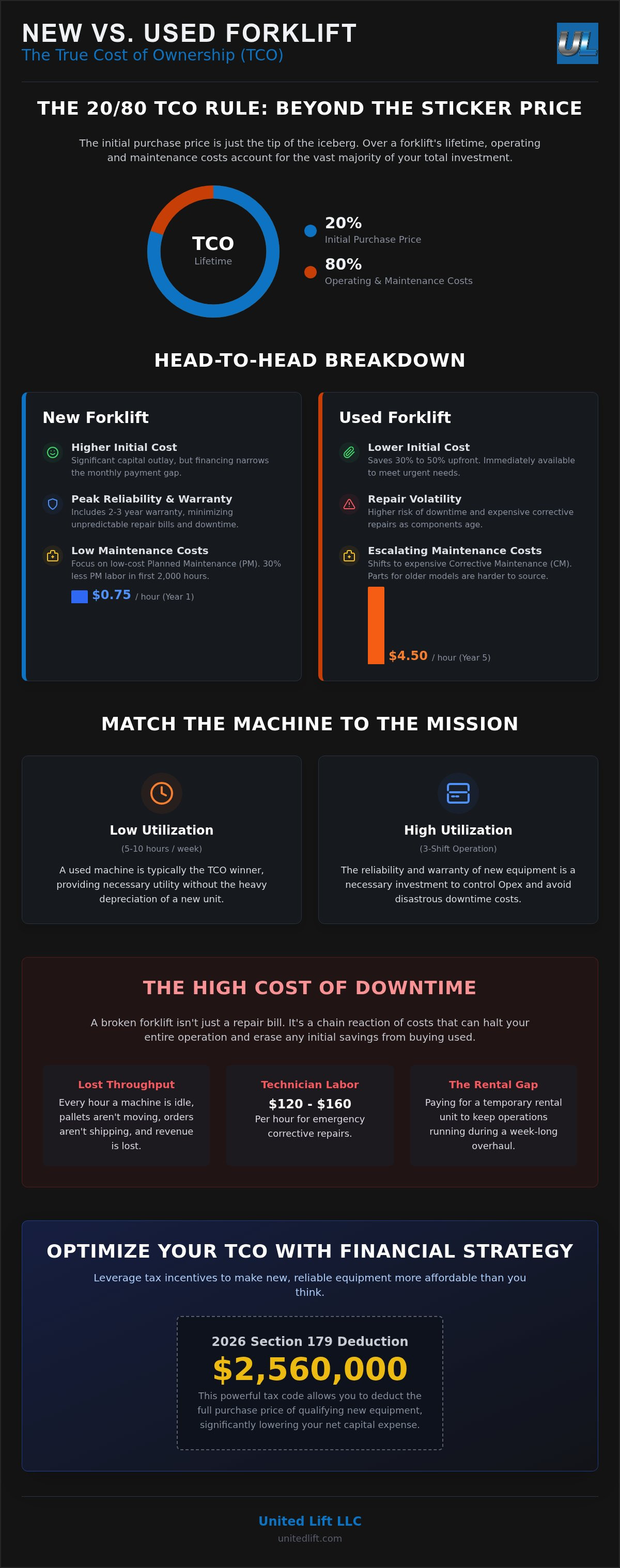
The industry follows a strict 20/80 rule. The initial purchase price represents about 20% of the total spend. The remaining 80% is tied to operating and maintenance costs. This ratio is why the new vs used forklift total cost of ownership looks different over a five-year period than it does on day one. In 2026, rising technician labor rates, often reaching $120 to $160 per hour, make these ongoing costs even more critical to your balance sheet.
Initial Capital Outlay: The Entry Barrier
The most obvious benefit of a used forklift is the lower entry price. You can often save 30% to 50% upfront compared to a brand-new model. For a business with tight cash flow, this Capex savings is huge. However, price isn't the only factor. Lead times for new equipment can stretch for months. Used units offer immediate availability. If you need to move pallets tomorrow, a used Yale or Hyster is often the only viable path. Financing also plays a key role. With 7-day-a-week financing assistance, the gap between monthly payments for new and used inventory is narrower than you might think.
The Role of Utilization in TCO
Your application determines your profitability. Are you running a low-hour or high-hour operation? If your forklift only runs 5 to 10 hours a week, a used machine is almost always the TCO winner. You get the utility you need without the heavy depreciation of a new unit. Conversely, a 3-shift, high-intensity environment is a different story. In these settings, a used unit can become a financial disaster. The high cost of downtime and frequent repairs will quickly wipe out any initial savings. For high-utilization fleets, the reliability of new equipment is a necessary investment to keep Opex under control.
New vs. Used Maintenance Profiles: Predicting Repair Volatility
Maintenance isn't a fixed line on your spreadsheet. It's an escalating curve that dictates your equipment strategy. When you analyze the new vs used forklift total cost of ownership, you'll find that new units focus on Planned Maintenance (PM), while older units shift toward expensive Corrective Maintenance (CM). New equipment usually includes a 2 to 3 year warranty that caps your repair exposure. While a new forklift typically averages $0.75 per operating hour in maintenance during its first year, a five-year-old unit often jumps to $4.50 per hour as major components begin to fail. In 2026, parts inflation and supply chain delays hit older models harder because specific components for legacy engines are becoming more expensive to source.
Planned Maintenance (PM) and Reliability
New forklifts require roughly 30% less PM labor during the first 2,000 hours of operation. Everything is fresh, tightened, and optimized. If you decide to go the pre-owned route, documented service history is your best friend. It proves the previous owner didn't skip oil changes or hydraulic flushes. At United Lift, we prioritize reliability by vetting every used unit for major wear before it hits our inventory. You can browse our current inventory to see high-quality options that avoid the common pitfalls of neglected machinery.
The Hidden Cost of Downtime
A broken forklift is more than just a repair bill. It's a shipping dock that has stopped moving. If you lose five pallets of throughput an hour, that cost dwarfs the $150 per hour you're paying a technician. You also have to account for the 'Rental Gap'. If your used lift needs a week-long engine overhaul, you'll have to pay for a temporary unit to keep your business running. This added expense is a major factor in the new vs used forklift total cost of ownership equation. High-intensity operations can't afford the risk of a unit being out of commission for days at a time.
Reliability is a choice. You can pay for it upfront with a new unit or pay for it later through unpredictable repairs and lost productivity. Balancing these costs requires a clear look at how many hours your equipment actually works each week.
Operating Costs: Fuel Efficiency and Labor Productivity
Fuel and labor are the daily engines of your operational budget. While the purchase price is a one-time event, these costs recur every hour your equipment runs. When evaluating the new vs used forklift total cost of ownership, you'll see that modern technology drastically changes the math. A 2026 internal combustion engine is significantly more efficient than a 10-year-old model. It uses less fuel to move the same amount of weight. If you're running a fleet of older units, you're likely paying a "hidden tax" in the form of wasted propane or electricity every single day.
The electric revolution has also matured. Newer Lithium-ion units might have a higher upfront cost, but they slash daily expenses. They don't require the watering or equalizing charges that older lead-acid batteries need. This shift to maintenance-free power sources is a major factor in reducing long-term TCO. By choosing newer tech, you're investing in a machine that spends more time on the floor and less time at the charging station.
Energy and Fuel Consumption
Is your fuel bill eating your profits? The five-year fuel cost delta between propane and electric units is substantial. Research indicates that electric forklifts can save a business between $10,000 and $15,000 over a five-year ownership period. This saving is driven by lower fuel costs and reduced maintenance requirements. In 2026, energy prices remain a volatile variable for internal combustion fleets. Newer electric models offer a way to lock in more predictable operating costs. While a used electric unit might seem cheaper, the cost of a new Lithium-ion battery can reach $20,000. If the used unit's battery is near the end of its life, your "bargain" disappears instantly.
Labor: The Largest TCO Component
Labor is often the elephant in the room. It accounts for up to 70% of total material handling costs. If your equipment is slow, uncomfortable, or difficult to operate, your labor costs per pallet will skyrocket. Newer Hyster and Yale models prioritize operator ergonomics to reduce fatigue. When drivers are comfortable, they move more pallets per hour. They're also less likely to make mistakes. Modern features like improved mast visibility and AI-powered pedestrian detection help prevent expensive impact damage to your racks and inventory.
Safe, modern equipment also gives you a recruitment edge. In a tight labor market, operators prefer driving newer machinery with better safety tech. This reduces turnover and training costs, which are critical parts of the new vs used forklift total cost of ownership. High-quality equipment isn't just a tool; it's a way to maximize the value of your most expensive asset: your people.
Depreciation and the 'Maintenance Inflection Point'
A new forklift is a high-performing asset, but it carries a heavy depreciation burden. You can expect a new unit to lose 20% to 30% of its market value in the first year alone. This steep drop is the price you pay for guaranteed uptime and a fresh factory warranty. Conversely, quality used units from premium brands like Toyota or Caterpillar often hit a 'value floor.' Once they reach a certain age and hour count, their price stabilizes. This stabilization makes them a safer bet for TCO recovery if you plan to keep the unit for a short period of light-duty work.
The 'Maintenance Inflection Point' is the pivot where your equipment strategy either succeeds or fails. This is the specific moment when your monthly repair bills and downtime losses exceed the cost of a new equipment lease. Tracking this number is the most effective way to manage the new vs used forklift total cost of ownership. If you are spending $1,200 a month to keep an aging lift running, but a new unit lease costs $900, your current strategy is draining your Opex. Continuing to repair a machine past this point is an emotional decision, not a financial one.
The Economic Life of a Forklift
Every machine has a retirement age. For most material handling equipment, 10,000 to 12,000 operating hours is the standard limit for TCO optimization. Beyond this point, the frequency of major component failures, like engine or transmission overhauls, increases sharply. You risk buying a 'lemon' if you don't know what to look for in a high-hour unit. To avoid these traps, read our guide on How to Buy a Used Forklift Like a Professional. Strategic replacement at the 10,000-hour mark allows you to capture residual value before the unit becomes a liability.
Resale and Trade-In Strategy
Maximizing your trade-in value requires more than just a clean paint job. Buyers want to see consistent Planned Maintenance (PM) records. These documents prove the machine was cared for, which directly impacts the new vs used forklift total cost of ownership by increasing your eventual resale recovery. Premium brands like Hyster, Yale, and Toyota consistently fetch higher prices on the secondary market because of their reputation for durability. At United Lift, we use our national network to provide competitive trade-in valuations that reflect the true market worth of your fleet. If you're ready to see what your current fleet is worth, you can get a trade-in valuation to help fund your next equipment upgrade.
Financing and Tax Strategy: Optimizing the TCO Equation
Financing is the final lever you can pull to manipulate your fleet's profitability. It transforms a massive upfront capital hit into a predictable monthly expense. When you look at the new vs used forklift total cost of ownership, your tax strategy often determines which option is the winner. In 2026, the financial incentives for upgrading your fleet are stronger than ever. Smart managers use these tools to trade volatile repair costs for stable, tax-advantaged payments.
One of the most effective ways to lower your TCO is the 'Fleet Swap' strategy. You might be struggling to maintain three older, high-hour used units that are constantly breaking down. By using financing, you can often replace those three machines with two highly efficient new ones. Newer models move more pallets per hour and require significantly less downtime. You end up with a more capable fleet and a lower total monthly spend.
Leveraging Section 179 in 2026
The tax code offers a major boost for equipment buyers this year. For the 2026 tax year, the Section 179 deduction limit is $2,560,000. This allows your business to deduct the full purchase price of qualifying new or used forklifts in the very first year. Instead of depreciating the asset over several years, you get the tax relief immediately. This effectively lowers your 'Net TCO' by thousands of dollars. Whether you are buying a new Hyster or a pre-owned Toyota, this deduction applies to both. We recommend consulting with your tax professional to see how this deduction can maximize your 2026 equipment budget.
Financing as a Tactical Tool
Cash flow is the lifeblood of any warehouse operation. Choosing to finance your equipment allows you to preserve working capital for other needs, like inventory or facility upgrades. United Lift provides financing assistance 7 days a week because we know your business doesn't stop on the weekend. Rapid financing means you can acquire the machinery you need exactly when you need it. This speed is critical when you're trying to avoid the high cost of downtime. For a complete look at how to navigate your next purchase, read The Ultimate Forklift Buying Guide for Industrial Success in 2026. Using financing as a tactical tool ensures your new vs used forklift total cost of ownership stays within a range that supports your long-term growth.
Take Control of Your Fleet's Profitability in 2026
Success in material handling requires looking beyond the initial sticker price. By mastering the 20/80 rule, you can identify exactly when a used machine's repair bills start to cannibalize your profits. Whether you choose the immediate savings of pre-owned inventory or the high-efficiency uptime of a new unit, your strategy must account for the 10,000 hour maintenance inflection point. Managing your new vs used forklift total cost of ownership is about balancing stable capital investments with predictable operating costs.
We specialize in premium Hyster, Yale, and Toyota equipment to ensure your fleet stays on the move. With nationwide shipping on all inventory and financing available 7 days a week, we're ready to help you upgrade your operations without the wait. Browse our national inventory of new and used forklifts and get financed today. Your next equipment move should be your most profitable one yet.
Frequently Asked Questions
What is the average total cost of ownership for a forklift over 5 years?
The average total cost of ownership for a forklift typically ranges from four to five times its initial purchase price over a five-year period. This calculation includes fuel, operator labor, and routine maintenance. If a new sit-down forklift costs $35,000, your total spend could reach $175,000 when accounting for all operational variables. Tracking these expenses helps you understand the true new vs used forklift total cost of ownership before you sign a contract.
Is it cheaper to maintain an electric or a propane forklift?
Electric forklifts are generally cheaper to maintain than propane models because they have fewer moving parts. They eliminate the need for engine oil changes, spark plugs, and transmission flushes. Research shows that switching to electric can save a business between $10,000 and $15,000 in fuel and maintenance costs over five years. While the upfront battery cost is higher, the daily operating expenses are significantly lower for modern fleets running multi-shift operations.
How much does a used forklift save on the initial purchase price?
Choosing a used forklift typically saves you between 30% and 50% on the initial purchase price compared to a new model. For example, a quality pre-owned unit with 3,000 to 5,000 hours of use often sells for $8,000 to $18,000, while a new equivalent might exceed $30,000. These upfront savings provide immediate capital relief, allowing you to allocate budget toward other warehouse infrastructure or inventory needs while still securing reliable machinery from premium brands.
When should I replace my forklift instead of repairing it?
You should consider replacing your forklift when individual repair costs exceed 50% of the unit's current market value or when annual maintenance costs surpass a new lease payment. Most equipment reaches a maintenance inflection point between 10,000 and 12,000 operating hours. At this stage, the frequency of major component failures increases. This leads to expensive downtime that often outweighs the cost of upgrading to a more reliable new or late-model used unit.
What are the 2026 labor rates for forklift technicians?
Average 2026 forklift technician labor rates are estimated between $120 and $160 per hour. These rates reflect the specialized skills required to maintain modern AI-powered safety features and complex electric drivetrains. Because technician labor is a major part of your Opex, choosing newer equipment with lower maintenance requirements is a strategic way to mitigate these rising costs. High labor rates make the new vs used forklift total cost of ownership calculation critical for high-utilization fleets.
Does Section 179 apply to used forklifts?
Yes, the Section 179 tax deduction applies to both new and used forklifts purchased and placed into service during the 2026 tax year. You can deduct the full purchase price up to a maximum limit of $2,560,000. This incentive is designed to encourage equipment upgrades by providing immediate tax relief. It effectively lowers the net cost of your machinery, making it easier to justify the acquisition of high-quality, lower-maintenance equipment for your national warehouse operations.
How many hours on a used forklift is too many for a high-intensity warehouse?
For a high-intensity, multi-shift warehouse, a used forklift with more than 5,000 hours is generally considered too risky for primary duty. High-intensity operations require maximum uptime to maintain throughput. Once a unit passes the 5,000-hour mark, the likelihood of corrective maintenance increases. In these environments, the cost of a single hour of downtime can quickly erase the initial savings gained by purchasing a pre-owned unit instead of a new one with a warranty.
Can financing help lower my forklift's total cost of ownership?
Financing helps lower your total cost of ownership by allowing you to acquire newer, more efficient equipment without a large capital outlay. By spreading the cost into predictable monthly payments, you can upgrade to machinery with lower fuel consumption and lower maintenance requirements. This shift from unpredictable repair bills to a fixed lease or loan payment stabilizes your budget. It ensures your team is always working with reliable, high-performing assets that minimize long-term operational expenses.
- Tags: Equipment Financing, Fleet Management, Forklift TCO, Material Handling Equipment, New vs Used Forklift, new vs used forklift total cost of ownership, Operating Costs, Section 179
